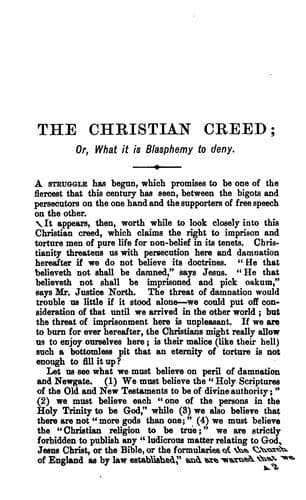
The Christian Creed; or, What it is Blasphemy to Deny — John Shaqi
The Christian Creed; or, What it is Blasphemy to DenyBesant, Annie
Religion
The Christian Creed; or, What it is Blasphemy to Deny
Besant, Annie
Christianity -- Controversial literature
It would be wearisome to recite all the extraordinary commands given by
god in this “third book of Moses.” Christians disregard them, on the
pretence that the ceremonial law is not binding on them, yet it is
blasphemy to deny that “whosoever shall break one of these least
commandments, and shall teach men so, he shall be called the least in
the kingdom of heaven” (Matt, v., 19).
It is blasphemy to deny that the hare chews the cud (xi., 6); as a
matter of mere fact it does nothing of the kind. It is blasphemy to deny
that the locust, the beetle, and the grasshopper have more than four
feet (xi., 21—23); as a matter of fact they each have six. It is very
awkward when fact and faith clash in this numerical fashion.
It is blasphemy to deny that god concerns himself with the way a man
cuts his beard; “neither shalt thou,” says he, “mar the corners of thy
beard” (xix., 27). Is it conceivable that the creator of the universe
should trouble himself with such barber’s work as this? If such a being
existed would it not rather be blasphemy to ascribe such directions to
him?
It is blasphemy to deny that Jahveh, like other gods of his time,
commanded human sacrifice. He says: “No devoted thing that a man shall
devote unto the Lord of all that he hath, both _of man_ and beast, and
of the field of his possession, shall be sold or redeemed; every devoted
thing is most holy unto the Lord. None devoted which shall be devoted
_of men_ shall be redeemed, but _shall surely be put to death_” (xxvii.,
28, 29). This abomination is commanded by divine authority, and he is in
danger of gaol and damnation who shall honestly repudiate the detestable
thing.
It is blasphemy to deny that Jahveh ordained the disgusting trial of a
wife suspected of infidelity which is related in Numbers v., 12—31. If
the “spirit of jealousy” come on a man, he is to bring his wife to the
priest. “And the priest shall take holy water in an earthern vessel; and
of the dust that is in the floor of the tabernacle the priest shall
take, and put it into the water;” this delectable but dirty drink is to
be swallowed by the woman, after a charm has been repeated by the
priest, as “an oath of cursing,” and if the woman has been unfaithful
the water will have very unpleasant physical results, while if the
suspicion of her husband be false “she shall be free.” This prompt way
of settling matters would obviate all the expenses and formalities of a
divorce court, and if the arrangement could be extended to include
unfaithful husbands, this Christian country would be saved much cost.
But though the Christians punish other people for unbelief they are
thorough infidels themselves in all practical matters. They would far
rather trust Sir James Hannen than dirty holy water, when they suspect
conjugal infidelity.
Public-domain text, read in full here on John Shaqi.
Reviews
Reviews
No reviews yet
Be the first to share your thoughts on this work.
Join the Discussion
Join the discussion
Sign in to leave a comment or review.
Sign InorCreate an account