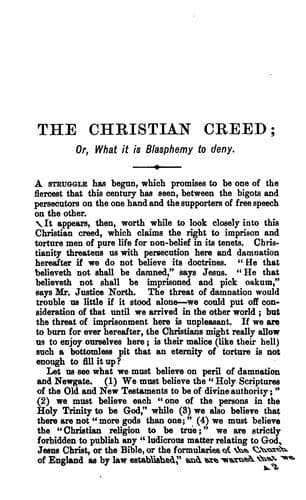
The Christian Creed; or, What it is Blasphemy to DenyBesant, Annie
Religion
The Christian Creed; or, What it is Blasphemy to Deny
Besant, Annie
Christianity -- Controversial literature
If possible, still viler is the treatment of captive women; when thou
“seest among the captives a beautiful woman, and hast a desire unto her
that thou wouldst have her to thy wife; then thou shalt bring her home
to thine house.... and after that thou shalt.... be her husband, and she
shall be thy wife. And it shall be if thou have no delight in her,” thy
passions being satisfied, “then thou shalt let her go whither she will”
(Deut. xxi., 11—14). No wonder that prostitution is rife in every
Christian city, when this command is placed before young men’s eyes as
“of divine authority.” Similar low views are taken in Deut. xxiv., 1.
While this degrading teaching is that of Jahveh, Manu, a mere man, with
no “divine authority,” but with only a human heart, taught his followers
to treat every aged woman as their mother, every young woman as their
sister.
It is rather odd to note in passing that he is declared to be cursed who
marries “his sister, the daughter of his father, or the daughter of his
mother” (Deut. xxvii., 22), when we remember that Abraham said of his
wife Sarah: “Indeed she is my sister; she is the daughter of my father,
but not the daughter of my mother; and she became my wife” (Gen. xx.,
12). Thus Abraham, who is so highly blessed in one part of god’s word,
is cursed in another.
The book of Joshua is taken up with the bloody wars of the Israelites;
it is a mere record of savage butchery; every page reeks with slaughter.
“They utterly destroyed all that was in the city, both man and woman,
young and old, and ox, and sheep, and ass, with the edge of the sword”
(Josh, vi., 21). This, repeated _ad nauseam_, is the book of Joshua. The
tale is varied now and then with the record of absurd miracles, as that
of the falling down of the walls of Jericho, or the standing still of
the sun and moon at the command of Joshua. From its ferocity and
absurdity, the book is beneath contempt, yet it is of “divine
authority.”
In the Book of Judges we have the record of a number of utterly
unimportant victories and defeats in the history of the Hebrew nation.
Why should these be accepted as “of divine authority” any more than any
corresponding history of some other equally obscure and barbarous
people?
Public-domain text, read in full here on John Shaqi.
Reviews
Reviews
No reviews yet
Be the first to share your thoughts on this work.
Join the Discussion
Join the discussion
Sign in to leave a comment or review.
Sign InorCreate an account