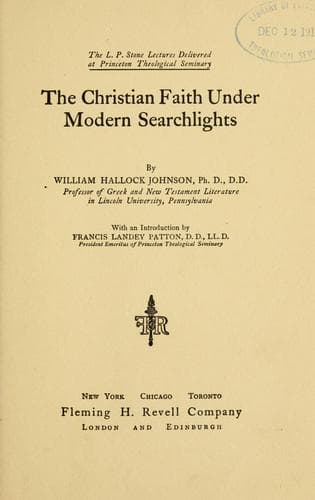
The Christian Faith Under Modern SearchlightsJohnson, William Hallock
Religion
The Christian Faith Under Modern Searchlights
Johnson, William Hallock
Modernism (Christian theology)
About the works of Homer, of Plato, of Dante and of Shakespeare there
has gathered a mass of material in the way of commentary and discussion,
but it is safe to say that in recent years the literary output in all of
these departments of study taken together is small in comparison with
that which centres around the Bible. The Biblical critic has helped to
attract to the Bible the intellectual interest of our age, as well as to
make it the storm-centre of theological controversy. He has made it a
principal object of scholarly as well as devotional interest, has thrown
a flood of light upon its pages from history, archæology, philology and
comparative religion, and has challenged the devout Bible reader to a
more intelligent, minute and painstaking examination of the fundamental
documents of his faith.
The specialization of the age has assigned the Old Testament and the New
Testament to different departments of study, and the problems of each
must be independently investigated. It is evident, though, that the
fortunes of the Old Testament and the New are closely bound up together.
The same principles of criticism are likely to be applied to both, and
whether we begin with naturalism or supernaturalism in the Old Testament
we shall probably end with it in the New Testament. In both Testaments
Babylonian influence may be traced, and the twelve apostles may follow
the twelve patriarchs into the limbo of myth. If no supernatural process
of redemption, in the way of history, prophecy or revelation, can be
discovered in the Old Testament, it is unlikely that any will be
discovered at all. The Fourth Gospel as well as the Pentateuch has been
analyzed into documents, and the same great historical transposition is
seen in both Testaments; Jewish monotheism is said to have begun with
Amos instead of with Abraham, and Christianity in its distinctive
features with Paul instead of with Jesus.
The present state of discussion in the Old Testament field indicates, to
one not a specialist in this department, that positions which have been
regarded as assured are not yet settled beyond question. The literary
analysis is ingenious and plausible, but, as is shown in Orr's "Problem
of the Old Testament," the argument is balanced. To offset the literary
analysis and the rearrangement of the history in accordance with an
evolutionary scheme, there are certain considerations from history,
archæology, and common reason. No such analysis has been ventured in the
case of modern documents that are confessedly composite, and in the case
of Homer, the nearest classical parallel, there is the same uncertainty
in the results.
Public-domain text, read in full here on John Shaqi.
Reviews
Reviews
No reviews yet
Be the first to share your thoughts on this work.
Elsewhere in the archive
Join the Discussion
Join the discussion
Sign in to leave a comment or review.
Sign InorCreate an account