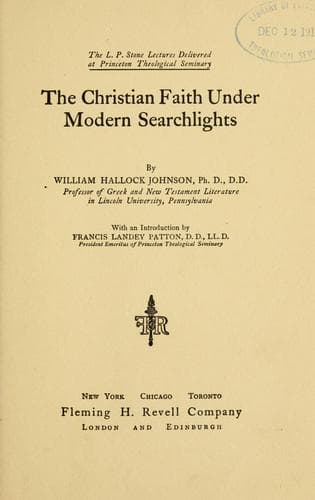
The Christian Faith Under Modern SearchlightsJohnson, William Hallock
Religion
The Christian Faith Under Modern Searchlights
Johnson, William Hallock
Modernism (Christian theology)
Purely literary considerations, as Ramsay has remarked, yield before
other more objective and historical data, and the literary theories are
adjusted to meet the new situation.[259] The temporary popularity in the
New Testament field of the Baur-Tübingen theories, based on Hegelian
principles of development, and then their general abandonment, suggest
the need of caution before we accept any concensus of criticism, based
upon literary and philosophical grounds alone, as the last word upon the
subject. Our special concern in this lecture is with the problems of the
New Testament, and we may consider briefly, I. The Pauline Epistles, II.
The Acts, III. The Synoptic Problem, and IV. The Johannine Problem.
259: "Luke the Physician," p. 262.
I. THE PAULINE EPISTLES
It is frequently said that the figure of the Apostle Paul stands out
against the background of history in bolder relief and with individual
features more strongly marked than does any other character in
antiquity. Not only has his public career been narrated by one who was
apparently his friend and companion in labours, but he has left a large
collection of letters, full of profound teaching upon religion and
ethics, and abounding in autobiographic details and in intimate
revelations of character.
The school of Baur recognized as genuine only the four central epistles,
Romans, 1 and 2 Corinthians and Galatians, making in bulk about
three-fifths of the writings, exclusive of Hebrews, which have been
assigned to Paul. The tendency of criticism since the time of Baur has
been steadily in the direction of the acceptance of other epistles as
Pauline. Colossians, Philippians and I Thessalonians have now been added
to the list of the generally accepted writings, and it is only the
fringe of Paul's writings that can be said to be still in dispute. Of
these "anti-legomena," 2 Thessalonians, Ephesians and the Pastorals, it
is noticeable that two of them are rejected largely on the ground that
they resemble so closely in ideas and vocabulary the admittedly Pauline
letters of I Thessalonians and Colossians, while a Pauline nucleus is
often acknowledged in the Pastorals by those who do not assign the
epistles as a whole to Paul.
Public-domain text, read in full here on John Shaqi.
Reviews
Reviews
No reviews yet
Be the first to share your thoughts on this work.
Elsewhere in the archive
Join the Discussion
Join the discussion
Sign in to leave a comment or review.
Sign InorCreate an account