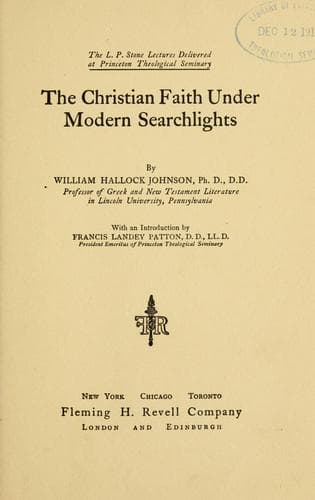
The Christian Faith Under Modern SearchlightsJohnson, William Hallock
Religion
The Christian Faith Under Modern Searchlights
Johnson, William Hallock
Modernism (Christian theology)
The course of the history in the early chapters of Acts is so different
from that which the imagination of a later age would have pictured, that
it bears upon its face the marks of early origin and of trustworthiness.
To a later writer, without contact with the actors, and writing after
the destruction of the Temple and the final breach of the Christians
with the Jews and the assured success of the Gentile mission, it would
seem exceedingly improbable (1) that the apostolic company should have
continued to worship in the Temple; (2) that they should at first have
found favour with the people; and (3) that they should have remained in
Jerusalem with no apparent intention of leaving until scattered by
persecution; and perhaps (4) that the Sadducees should have been the
first to start the persecution. The recorded history, improbable to a
later age, bears upon its face the stamp of truth. The imagination of a
post-Pauline writer would have given us, we may be sure, a very
different picture of church history. It would scarcely have conceived of
the primitive Christology of Peter's speeches, the use of the term,
"child," or "servant" of God (παῖς [pais]) in place of the Pauline term,
"Son of God" (υἱός [huios]), yet with the same attitude, shared by
Christians of earlier and later time, of adoration, worship and love.
The presumption in favour of credibility is strengthened by the author's
full and detailed treatment of persons and places. "A man who would
venture to introduce ninety-five persons and a hundred and three places
into a history of his own times must have been pretty sure of his
ground. The majority of these persons were still living when he wrote;
into every one of these places his volume shortly penetrated.... The
correctness of his geography upholds the truth of his history."[262]
262: Arthur Wright: "Some New Testament Problems," pp. 88, 89.
A great many of the statements of the Acts can be checked by comparison
with Paul's epistles, as has been shown by Paley's "Horæ Paulinæ," and
more recently, for the first part of the Acts, by Harnack. In case of
apparent conflict, it has been said, "we are confronted by the task of
reconciling the differences between two first-century documents, each of
which has, admittedly, very powerful claims."[263] More than half of the
Acts is taken up with the labours of the Apostle Paul, and yet the Acts
does not mention or show knowledge of his epistles. This fact, used by
some to throw doubt upon the genuineness of the epistles, may be an
indication of the early date of the Acts, and of so close a relationship
between the author and the Apostle that the evidence of letters would be
unnecessary.
263: Dawson Walker: "The Gift of Tongues," 1906, p. 181.
Public-domain text, read in full here on John Shaqi.
Reviews
Reviews
No reviews yet
Be the first to share your thoughts on this work.
Elsewhere in the archive
Join the Discussion
Join the discussion
Sign in to leave a comment or review.
Sign InorCreate an account