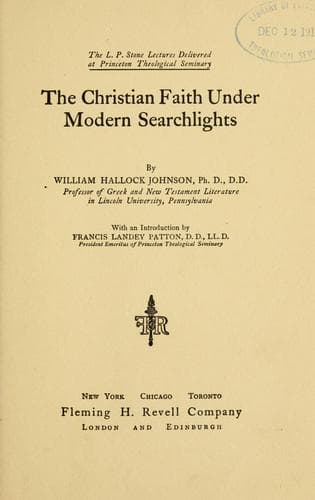
The Christian Faith Under Modern SearchlightsJohnson, William Hallock
Religion
The Christian Faith Under Modern Searchlights
Johnson, William Hallock
Modernism (Christian theology)
Important alike in its bearing upon the questions of credibility and
authorship, is the evidence of the so-called "we-sections." A _prima
facie_ case is made out that the author of the Acts was an eye-witness
of some of the scenes it records, and a companion in travel of the
Apostle Paul. This evidence has of late been greatly strengthened by
linguistic investigation. While critical attempts are still made to
divide the Acts into documents, the "we-sections" (xvi. 10-17; xx. 5-15;
xxi. 1-18; xxvii. 1-xxviii. 16), as Sir J. Hawkins says, show an
"immense balance of internal and linguistic evidence in favour of the
view that the original writer of these sections was the same person as
the main author of the Acts and of the Third Gospel."[264]
264: "Horæ Synopticæ," 2d ed., 1909, p. 188.
No living writers have done more to stimulate interest in the book of
Acts than have Sir W. M. Ramsay and Harnack, and the writings of both
have materially strengthened the case alike for its Lukan authorship,
and, in the main, for its historical accuracy. Ramsay, starting, as he
says, from the standpoint of the Tübingen school, "with the confident
assumption that the book was fabricated in the middle of the second
century, and studying it to see what light it could throw on the state
of society in Asia Minor, was gradually driven to the conclusion that it
must have been written in the first century and with admirable
knowledge."[265]
265: "Pauline Studies," p. 199.
Harnack's defense, in his four monographs,[266] of the Lukan authorship,
integrity, historical reliability (where the supernatural is not in
question) and early date of the Acts is the most outstanding and
significant achievement of the age in New Testament criticism. Harnack's
work has been so thorough and convincing that it may be said to have
carried the theological world by storm. At least his powerful argument
for Lukan authorship does not appear to have been successfully met. The
attempt to turn its flank by asserting that the Paul of Acts, in making
a vow, shaving his head and entering into the Temple, was not the
defender of Gentile liberty who wrote Galatians, and so that the author
of the Acts was not the companion of Paul, is met by Harnack in the
fourth of his monographs. Paul, he declares, not only was a Jew, but
remained so, whether consistently or not. Harnack thinks that Paul
shrank back from taking the last logical step,[267] but that in this the
author of the Acts represents the relation of Paul to Judaism precisely
as do his letters.[268] Stanton well remarks that the difficulty of
accounting for alleged discrepancies between the Acts and the Epistles
is equal or greater on the supposition that the author wrote 100 A. D.,
or later, than if the author was the companion of Paul.[269] The very
fact, for example, that Luke says that Paul worshipped in the Temple is
an indication that we have here no conception of a later age to which
such an act would have seemed unnatural.
Public-domain text, read in full here on John Shaqi.
Reviews
Reviews
No reviews yet
Be the first to share your thoughts on this work.
Elsewhere in the archive
Join the Discussion
Join the discussion
Sign in to leave a comment or review.
Sign InorCreate an account