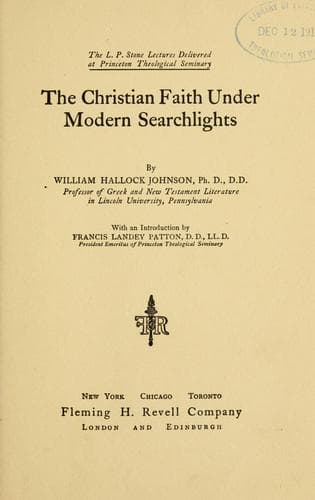
The Christian Faith Under Modern SearchlightsJohnson, William Hallock
Religion
The Christian Faith Under Modern Searchlights
Johnson, William Hallock
Modernism (Christian theology)
The question of date cannot be said to be absolutely settled, but the
tendency of criticism as illustrated by Harnack is to the acceptance of
an early date, as well as to that of the Lukan authorship of the entire
book. It is difficult to see how Harnack, with his present defense of a
date before Paul's release from prison, can consistently maintain his
skepticism where the supernatural events recorded in the Acts are
concerned. It is idle to say that his "revolution in chronology" has no
effect upon the question of reliability. It is an established principle
of historical method that the nearer a tradition is to the event it
professes to describe, the more likely it is to be trustworthy. The
resources of Harnack's learning have been used in support of the
reliability of Luke in his geographical and chronological
references,[275] and his treatment of persons and reports of their
speeches.[276] He has shown that Luke was in touch with the leaders of
the Jerusalem church, and that his statements are abundantly confirmed
by the writings of Paul. If Luke wrote within the lifetime of Paul, the
Acts was published while the main actors were still living, and, by
inference, it recorded events as Peter and Barnabas and Apollos and
Philip and Mark thought that they happened. If further, as Harnack
argues, it was written during Paul's imprisonment there seems no room
for doubt that it was written under the eye and with the full
endorsement of its principal actor, and that we have thus the implicit
guarantee not only of Luke but of Paul also for the accuracy of its
record.
275: III, p. 97; "Acts of the Apostles," p. 112.
276: _Ibid._, pp. 101 ff.; E. T., pp. 117 ff.
III. THE SYNOPTIC PROBLEM
It has been said that the two most important questions for religion are
those of the rational foundations of theism and of the trustworthiness
of the Four Gospels.[277] The Gospel records have always been regarded as
the citadel of the Christian Faith. Not only do they contain the record
of works of power and words of grace, and of a transcendent Personality,
but they have always been considered to have been themselves
supernatural in origin and character. They have been regarded as "a
house not made with hands" (Robertson Nicoll), "a miracle of the Holy
Ghost" (Stier), "the heaven-drawn picture of Christ, the living Word."
The criticism of the past century, in its quest for the historical
Jesus, has taken a very different attitude towards the Evangelical
records. By many critics they have been regarded as a patchwork of
traditions, a work of pious but credulous men, whose idealization and
exaggeration, in the supposed interest of faith, it is necessary to
discount in order to reach the bed-rock of historical fact.
277: Dr. Francis L. Patton, in an address.
Public-domain text, read in full here on John Shaqi.
Reviews
Reviews
No reviews yet
Be the first to share your thoughts on this work.
Elsewhere in the archive
Join the Discussion
Join the discussion
Sign in to leave a comment or review.
Sign InorCreate an account