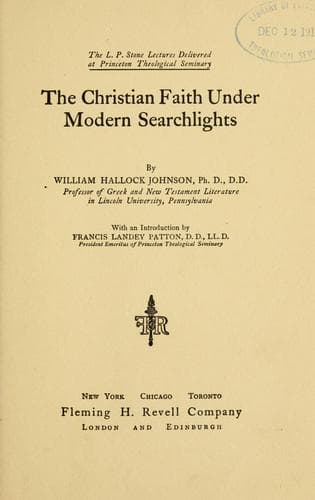
The Christian Faith Under Modern SearchlightsJohnson, William Hallock
Religion
The Christian Faith Under Modern Searchlights
Johnson, William Hallock
Modernism (Christian theology)
The leading argument against an early date for the Acts is drawn from
the possible use by Luke of the writings of Josephus, and the crux of
the question is in the words put into the mouth of Gamaliel (Acts v. 36,
37). The coincidence of the names of Theudas and Judas of Galilee (Acts
v. 36, 37; Antiq. xx. v. 1 and 2) is striking and, if the two men named
Theudas be identified and Josephus is correct, Luke is guilty of an
anachronism in putting an allusion to him into the mouth of Gamaliel;
for the Theudas of Josephus falls in the time of Fadus who was
procurator under Claudius, about 45 A. D. The following points deserve
to be noticed:
(1) Luke had from Paul, whether or not Paul was present at the meeting
of the Sanhedrin, the best means of knowing what Gamaliel, his teacher
and the spokesman of the Pharisaic party, actually said. (2) The
assumption that Luke was quoting Josephus is in itself very difficult
when we compare the passages. Luke speaks of about four hundred under
Theudas while Josephus mentions a great part of the people; Luke speaks
of Judas while Josephus speaks of the sons of Judas. To quote thus
loosely from his assumed authority and then to commit the further
blunder of making Gamaliel allude to an event which occurred at least a
dozen years later is, while possible, strangely out of keeping with
Luke's proved care and accuracy in most of his historical allusions. The
difficulty is acknowledged by those who make Luke dependent on Josephus.
Why did Luke diverge from a correct narrative if he had one before him?
Writers who affirm (Holtzmann) and those who deny (Schürer) the
dependence on Josephus practically agree that if Luke had read Josephus
he had forgotten him. (3) In the narrative of the death of Herod (Acts
xii. 20 f.; Antiq. xix. viii. 2), where the two authors most obviously
come together, both are plainly describing the same event, and yet seem
to be quite independent both in the use of words and in the details of
the description. (4) The cumulative evidence of an early date for Luke
weighs heavily in the scale against the hypothesis of dependence upon
the "Antiquities" written about 93 or 94 A. D.
Public-domain text, read in full here on John Shaqi.
Reviews
Reviews
No reviews yet
Be the first to share your thoughts on this work.
Elsewhere in the archive
Join the Discussion
Join the discussion
Sign in to leave a comment or review.
Sign InorCreate an account