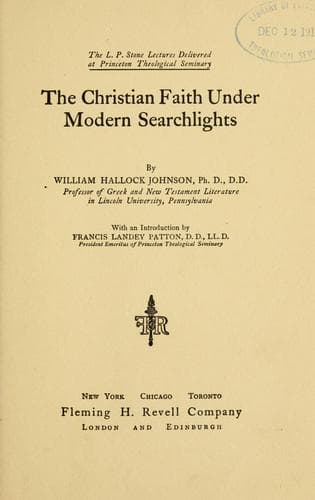
The Christian Faith Under Modern SearchlightsJohnson, William Hallock
Religion
The Christian Faith Under Modern Searchlights
Johnson, William Hallock
Modernism (Christian theology)
Those who push back the influence of the mysteries upon the sacraments
to the teaching of Paul himself are compelled to interpret the Apostle's
language, contrary, we believe, to the best exegetical tradition, in a
physical or what is called an _ex opere operato_ sense. It is
significant that when the sacraments are so interpreted they appear to
be a foreign element in Paul's system. "It is no wonder that
interpreters like Heitmüller and Weinel, who attribute a magical view of
the sacraments to Paul, are concerned to point out that his
sacramentalism is a sort of erratic boulder in his system as a
whole."[241] We are reminded of Clemen's principle that the sense of the
New Testament passage should be fully ascertained before dependence is
assumed.
241: Kennedy: "St. Paul and the Mystery Religions," p. 283.
When von Dobschütz says that "the unique sacramental conception of the
Early Church, which has no analogy in the history of religion because it
belongs essentially to the Christian religion, has its origin solely in
Christian faith and Christian experience,"[242] the same may be said of
Paul's doctrine of dying and rising again with Christ. When Paul says
"buried with him in baptism" (Rom. vi. 4 and Col. ii. 12), he speaks of
no pantheistic or magical union with the deity such as seemed to
dominate the thought of the mysteries, so far as their meaning can be
ascertained. In both contexts Paul immediately goes on to exhortation.
"Let not sin reign" (Rom. vi. 12), "Seek the things above; mortify your
members" (Col. iii. 1-5). It should further be noticed that the passage
most relied upon to prove Paul's borrowing from the mysteries (Rom. vi.)
was addressed to a church which Paul did not found, composed of both
Jewish and Gentile Christians. The doctrine in question was not put
forth as a novelty, but is assumed to be known to them: "Are ye
ignorant, etc.?" (Rom. vi. 3).
242: Kennedy: "St. Paul and the Mystery Religions," quoted, p. 279.
Public-domain text, read in full here on John Shaqi.
Reviews
Reviews
No reviews yet
Be the first to share your thoughts on this work.
Elsewhere in the archive
Join the Discussion
Join the discussion
Sign in to leave a comment or review.
Sign InorCreate an account