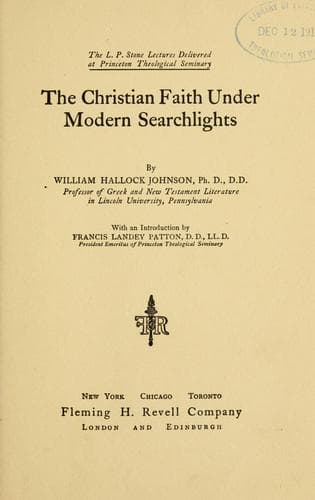
The Christian Faith Under Modern SearchlightsJohnson, William Hallock
Religion
The Christian Faith Under Modern Searchlights
Johnson, William Hallock
Modernism (Christian theology)
Paul's doctrine of dying and rising with Christ is ethical rather than
"metaphysical" or magical or sacramental. It is surprising to find how
little sacramental it is. With no allusion to his own baptism or to the
Lord's Supper he says, "I have been crucified with Christ. The world is
crucified to me and I to the world" (Gal. ii. 20; vi. 14). "Christ died
for all, therefore all died" (2 Cor. v. 14). "To know Christ, to be
found in him, to be transformed into his death" (Phil. iii. 8 f.). His
doctrine is based upon a personal experience of grace, and this is
associated with the Cross rather than with the sacraments. The bond
which mediated his union with Christ in His death was faith. It was
through faith that the Spirit is to be received (Gal. iii. 14), and
even when he says, "Christ liveth in me," he adds, "I live in the faith
of the Son of God" (Gal. ii. 20, and see Eph. iii. 17). He would gain
Christ that he might have "the righteousness of God through faith"
(Phil. iii. 9). The Cross and not the sacraments was central alike in
the Apostle's experience and in his doctrine of dying and rising with
Christ, and the bond of union between him and Christ was faith. There
was no mystical absorption of personality as in the Hermetic prayers:
"Thou art I, and I am thou."
Finally the Pauline mystery was distinguished from the heathen mysteries
by its connection with an historical Person. In the Pauline mystery, it
has been said, the divine appeared in a "concrete and comprehensible
guise," and "this connection of a religious principle with a Person who
had walked upon earth and suffered death was a phenomenon of singular
power and originality."[243] There is a world of difference between the
nature-myths, underlying the mysteries, of the annually dying and rising
vegetation gods, without historical reality, and promising to the
initiated release from transitoriness and mortality, and the record of
Christ who died for our sins, and who being raised from the dead dieth
no more. To say that Paul not only conformed the Lord's Supper to the
heathen mysteries, but invented it in imitation of the mysteries, is to
accuse him of deliberate misstatement; for in a passage of unusual
solemnity (I Cor. xi. 23 ff.), he says that he received it of the Lord,
and relates the circumstances of the institution of the Supper by Jesus
Himself.
243: Bousset: "Kyrios Christos," p. 148.
Public-domain text, read in full here on John Shaqi.
Reviews
Reviews
No reviews yet
Be the first to share your thoughts on this work.
Elsewhere in the archive
Join the Discussion
Join the discussion
Sign in to leave a comment or review.
Sign InorCreate an account