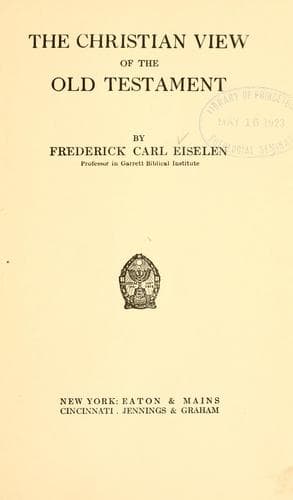
The Christian View of the Old TestamentEiselen, Frederick Carl
Religion
The Christian View of the Old Testament
Eiselen, Frederick Carl
Bible. Old Testament -- Criticism, interpretation, etc.
Another important point, to which attention has already been called, is
the marked difference which obtains between the literature of the Old
Testament and that uncovered by archæology. True, there are points of
contact; indeed, strange it would be if there were none; for, like the
Babylonians, the Hebrews were Semites. Surely, it is not strange that
nations of the same race, originally in the same home, should possess
similar traditions, customs, beliefs, and practices. When they left
their common home they carried with them their common traditions,
customs, and beliefs; in their new homes they developed them and
impressed upon them their own individualities. We are nowhere informed
in the Old Testament, and it would seem contrary to reason to suppose,
that at the time of Abraham, Moses, or at any other period, God emptied
the Hebrew mind and {221} consciousness of all the things which had
been the possession of the Semitic race from the beginning. Is it not
more likely that the inspired teachers and writers employed for their
loftier purposes the ancient traditions and beliefs familiar to their
contemporaries? In doing so they took that which was, in some cases,
common and unclean, and, purifying it under the guidance of the Divine
Spirit, made it the medium by which to impart the sublimest truths ever
presented to man. Obviously, the special religious value of the Old
Testament literature does not lie in what is common to it and Babylon,
but in the elements in which they differ.
The points of contact must not blind the eye to the points of contrast.
These points of contrast are in the spirit and atmosphere pervading the
Hebrew Scriptures, which are quite distinct, not simply from
Babylonian, but from all other literatures. These essential
differences occur, as we have seen, throughout the entire religious and
ethical literature. In many cases is agreement in form, but how far
superior the spirit and substance of the Hebrew! Think of the
different conceptions of the nature and character of God, of God's
relation to man, of the divine government of the world, and many other
truths precious to Christians in all ages. There is, indeed, in the
Hebrew record "an intensity of spiritual {222} conception, a sublimity
of spiritual tone, an insight into the unseen, a reliance upon an
invisible yet all-controlling Power, that create the gap between the
Hebrew and his brother Semite beyond the River."
Public-domain text, read in full here on John Shaqi.
Reviews
Reviews
No reviews yet
Be the first to share your thoughts on this work.
Elsewhere in the archive
Join the Discussion
Join the discussion
Sign in to leave a comment or review.
Sign InorCreate an account