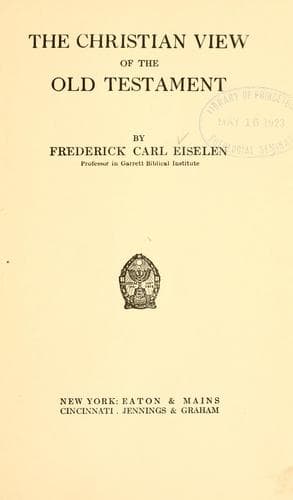
The Christian View of the Old TestamentEiselen, Frederick Carl
Religion
The Christian View of the Old Testament
Eiselen, Frederick Carl
Bible. Old Testament -- Criticism, interpretation, etc.
How are we to account for these differences? Professor Sayce has
suggested an answer in these words: "I can find only one explanation,
unfashionable and antiquated though it be. In the language of a former
generation, it marks the dividing line between revelation and
unrevealed religion. It is like that something hard to define which
separates man from the ape, even though on the physiological side the
ape may be the ancestor of man."[43] Though the language of this
statement may be unfortunate, especially where it implies that there is
no revelation in the ancient religions outside of the Old Testament, it
does call attention to the secret of the fundamental difference between
the Old Testament sacred literature and that of the surrounding
nations. There is in the former abundant evidence of the activity of a
Spirit whose presence is less manifest in the sacred literatures of
other ancient nations.
True, the monuments have not spoken their last word; but if we have the
right to draw inferences from the known, we may safely affirm that
though the monuments may swell into infinity, they will offer nothing
to equal, much less to supersede, in substance and spirit, our {223}
Old Testament. We may receive gratefully every ray of light, but the
time has not yet come, nor ever will come, when we may lay aside the
Old Testament and accept as a substitute the legends and myths of
heathen lands to give to us the bread of life which the Saviour found
in the pages of the Old Book. Let us welcome the light and knowledge
God has bestowed upon us; let us rejoice in them with perfect assurance
that they are for good and not for evil; let us learn to use them
wisely and honestly, and let us still be ever alert listening for other
words, uttered ages ago, but not yet audible to modern ears. "It is
for us to catch these messages, and to understand them, that we may fit
them into the great fabric of apprehended truth to the enrichment of
ourselves, and to the glory of our common Lord."
NOTES ON CHAPTER V
[1] J. P. Peters, The Old Testament and the New Scholarship, p. 92.
[2] S. G. Smith, Religion in the Making, p. 20.
[3] Hugo Winckler, Himmels- und Weltenbild der Babylonier, p. 9.
[4] Professor Friedrich Delitzsch, of the University of Berlin,
delivered three lectures on the relation of Babylonian religion to the
religion of the Old Testament, under the title, "Babel und Bibel."
[5] A. H. Sayce, The Religions of Ancient Egypt and Babylonia, pp. 276,
277.
[6] A. Jeremias, The Old Testament in the Light of the Ancient East, I,
p. 86.
{224}
[7] R. W. Rogers, The Religion of Babylonia and Assyria, p. 88.
Practically all the cuneiform inscriptions quoted or referred to in
this chapter are translated in R. W. Rogers, Cuneiform Parallels to the
Old Testament.
[8] Friedrich Delitzsch, Babel and Bible, Two Lectures, published by
Open Court Co., p. 65.
Public-domain text, read in full here on John Shaqi.
Reviews
Reviews
No reviews yet
Be the first to share your thoughts on this work.
Elsewhere in the archive
Join the Discussion
Join the discussion
Sign in to leave a comment or review.
Sign InorCreate an account