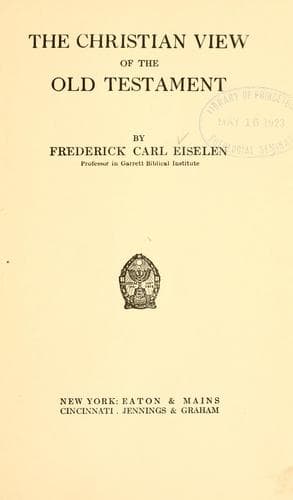
The Christian View of the Old Testament — John Shaqi
The Christian View of the Old TestamentEiselen, Frederick Carl
Religion
The Christian View of the Old Testament
Eiselen, Frederick Carl
Bible. Old Testament -- Criticism, interpretation, etc.
Former generations found the principal arguments in favor of the belief
in a divine element in the Old Testament in the presence of miracles in
its records and in the fulfillment of prophecy. The present generation
cannot depend upon these arguments exclusively. The whole question of
miracles in the Old Testament has assumed a different aspect within
recent years. In the first place, it is seen that in some places where
formerly a miracle was thought to have been wrought natural causes may
have played a prominent part, as, for example, in the crossing of the
Red Sea and the Jordan. In other cases language which used to be
interpreted literally is now seen to be poetic and imaginative. In
still other cases the absolute historical accuracy of certain
narratives has come to be questioned. All this has resulted in a
weakening of the evidence relied upon by former generations.
Approaching the subject of miracles from another side, a better
acquaintance with the uniformity of nature and the laws of nature has
led some to question even the possibility of miracles, while the
greater emphasis upon the immanence of God has resulted {28} in altered
conceptions of the natural and supernatural, if not in an almost
complete obliteration of any distinction between the two. Since
miracles are involved in so much uncertainty, they do not at present
constitute a very strong argument to prove the presence of a divine
element in the Old Testament to one who is at all skeptically inclined;
indeed, there are many sincere Christians who find miracles useless as
an aid to faith.
In a similar manner, one cannot appeal with the same assurance as
formerly to the fulfillment of prophecy. It is undoubtedly true that
many prophetic utterances were fulfilled; it is equally true that some
were not fulfilled. If, however, the apologist depends upon the
fulfillment of prophecy as a proof, the nonfulfillment of even a single
one weakens his position. Moreover, it is recognized at present that
prophecy in the sense of prediction occupies a relatively insignificant
place in the Old Testament. Besides, scientific methods of study have
shown that some passages interpreted formerly as predictions can no
longer be so interpreted, while in the case of others the
interpretation is more or less doubtful. Here, again, the difficulties
connected with the use of the argument have become so perplexing that
many consider it wise not to use it at all. If used with caution,
prophecy, especially Messianic {29} prophecy, possesses great
evidential value; but the argument from the fulfillment of prophecy as
used formerly has lost much of its worth as a proof of inspiration.
The arguments relied upon at the present time are simpler than those of
the past, and are of such a nature that any fair-minded student can
test them.
Public-domain text, read in full here on John Shaqi.
Reviews
Reviews
No reviews yet
Be the first to share your thoughts on this work.
Join the Discussion
Join the discussion
Sign in to leave a comment or review.
Sign InorCreate an account