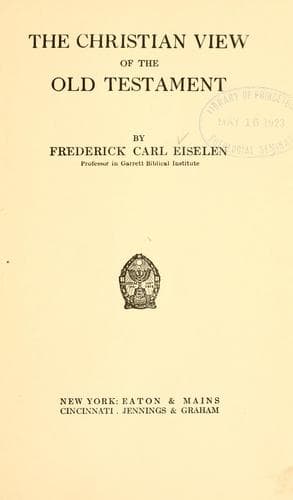
The Christian View of the Old TestamentEiselen, Frederick Carl
Religion
The Christian View of the Old Testament
Eiselen, Frederick Carl
Bible. Old Testament -- Criticism, interpretation, etc.
This being the case, students of the Bible should return to a more just
appreciation of that part of Sacred Scripture which is so intimately
connected with the training of Jesus and his disciples. If the Old
Testament contains records {234} and interpretations of divine
revelations, those who claim to be children of God should be willing,
yea, anxious, to put forth some efforts to familiarize themselves
adequately with these records. But the sense of gratitude and
appreciation for these self-revelations of God is not the only reason
which should prompt the Christian to turn more frequently to the pages
of the Old Book. A much more important consideration is the fact that
the lessons taught in the Old Testament are of profound significance
to-day, and that they cannot be neglected without serious consequences.
Again, attention may be called to the fact that the Founder of
Christianity and his disciples found nourishment in its pages, and that
they constantly exhorted their followers to do the same. Now, Jesus is
recognized by all Christians as a model worthy of imitation in every
relation of life. Would it not be well to imitate him in the use of
the Old Testament Scriptures? If he found in the pages of the Old
Testament weapons with which to put to flight the Evil One, might not
we? Aside from these general considerations, it is easily shown that
every part of the Old Testament is full of teaching which is of the
highest value even in the twentieth century of the Christian era.
Consider, for example, the first eleven chapters of Genesis, around
which much controversy has raged. In former days these chapters were
{235} thought to give an absolutely accurate account of creation and
the early history of mankind. However, various lines of investigation
have shown this view to be untenable. "We are forced, therefore," says
a recent writer, "to the conclusion that, though the writers to whom we
owe the first eleven chapters of Genesis report faithfully what was
currently believed among the Hebrews respecting the early history of
mankind, yet there was much they did not know, and could not take
cognizance of. These chapters, consequently, contain no account of the
real beginnings, either of the earth itself, or of man and human
civilization upon it."[8] All this need create not the slightest
difficulty for one who holds the scriptural conception of the nature
and purpose of the biblical writings. It is true of these chapters, as
of other parts of the record, that "the only care of the prophetic
tradition is to bring out clearly the religious origin of humanity.[9]
If anyone is in search of accurate information regarding the age of
this earth, or its relation to the sun, moon, or stars, or regarding
the exact order in which plants and animals have appeared upon it, he
should go to recent textbooks in astronomy, geology, and paleontology.
It is not the purpose of the writers of Scripture to impart physical
Public-domain text, read in full here on John Shaqi.
Reviews
Reviews
No reviews yet
Be the first to share your thoughts on this work.
Elsewhere in the archive
Join the Discussion
Join the discussion
Sign in to leave a comment or review.
Sign InorCreate an account