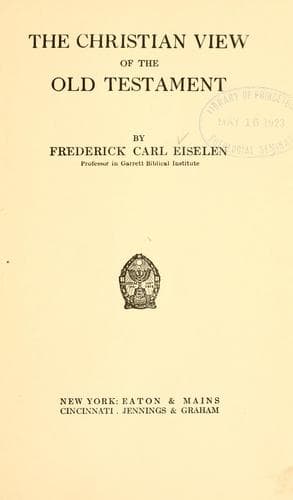
The Christian View of the Old TestamentEiselen, Frederick Carl
Religion
The Christian View of the Old Testament
Eiselen, Frederick Carl
Bible. Old Testament -- Criticism, interpretation, etc.
instruction, or to enlarge the bounds of scientific knowledge. So far
as the {236} scientific or historical information imparted in these
chapters is concerned, it is of little more value than the similar
stories of other nations. And yet the student of these chapters can
see a striking contrast between them and extra-biblical stories
describing the same unknown ages handed down from pre-scientific
centuries. Here comes to view the uniqueness of the Bible. The other
traditions are of interest only as relics of a by-gone past. Not so
the biblical statements; they are and ever will be of inestimable
value, not because of their scientific teaching, but because of the
presence of sublime religious truth in the crude forms of primitive
science. If anyone wishes to know what connection the world has with
God, if he seeks to trace back all that now is to the very
fountain-head of life, if he desires to discover some unifying
principle, some illuminating purpose in the history of the earth, he
may turn to these chapters as his safest and, indeed, only guide to the
information he seeks.
The purpose of the narratives being primarily religious, it is only
natural that their lessons should be religious lessons. The one
supreme lesson taught throughout the entire section is "In the
beginning, God." But each separate narrative teaches its own peculiar
lessons. The more important of these are briefly summarized by Driver
as follows: "The narrative of creation {237} sets forth, in a series of
dignified and impressive pictures, the sovereignty of God; his priority
to and separation from all finite, material nature; his purpose to
constitute an ordered cosmos, and gradually to adapt the earth to
become the habitation of living beings; and his endowment of man with
the peculiar, unique possession of self-conscious reason, in virtue of
which he became capable of intellectual and moral life, and is even
able to know and hold communion with his Maker. In chapters two and
three we read, though, again, not in a historical but in a pictorial
and symbolic form, how man was once innocent, how he became conscious
of a moral law, and how temptation fell upon him and he broke that law.
The fall of man, the great and terrible truth, which history not less
than individual experience only too vividly teaches each one of us, is
thus impressively set before us. Man, however, though punished by God,
is not forsaken by him, nor left in his long conflict with evil without
hope of victory. In chapter four the increasing power of sin, and the
fatal consequence to which, if unchecked, it may lead, is vividly
portrayed in the tragic figure of Cain. The spirit of vindictiveness
and the brutal triumph in the power of the sword is personified in
Lamech. In the narrative of the Flood God's wrath against sin and the
divine prerogative of mercy are alike exemplified: {238} Noah is a
standing illustration of the truth that 'righteousness delivereth from
Public-domain text, read in full here on John Shaqi.
Reviews
Reviews
No reviews yet
Be the first to share your thoughts on this work.
Elsewhere in the archive
Join the Discussion
Join the discussion
Sign in to leave a comment or review.
Sign InorCreate an account