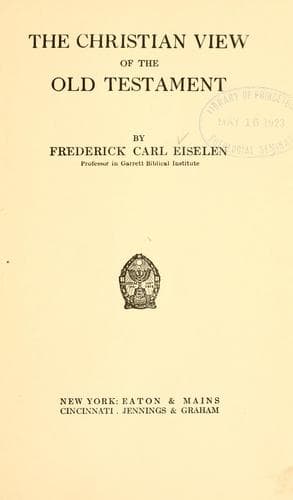
The Christian View of the Old TestamentEiselen, Frederick Carl
Religion
The Christian View of the Old Testament
Eiselen, Frederick Carl
Bible. Old Testament -- Criticism, interpretation, etc.
death,' and God's dealings with him after the Flood form a striking
declaration of the purposes of grace and good will with which God
regards mankind. The narrative of the Tower of Babel emphasizes
Jehovah's supremacy in the world, and teaches how the self-exaltation
of man is checked by God."[10]
These chapters are followed by the stories of the patriarchs.
Missionaries say--and experience at home has confirmed the claim--that
the patriarchal narratives are of inestimable value to impress lessons
of the reality and providence of God, and to encourage the exercise of
faith and confidence in him. There is nothing that can be substituted
for them in religious instruction. Lack of space will not permit to
point out in detail the educational value of these documents; however,
in passing, mention may be made of the fact that Professor W. W. White
enumerates twenty-one Christian virtues that are illustrated and
enforced in the life of Abraham.[11] He was (1) steadfast, (2)
resolute, (3) prudent, (4) tactful, (5) candid, (6) kind, (7)
self-controlled, (8) obliging, (9) self-denying, (10) condescending,
(11) unselfish, (12) peaceable, (13) hospitable, (14) courteous, (15)
humble, (16) thankful, (17) reverent, (18) prayerful, (19) worshipful,
(20) faithful, {239} (21) obedient. Not one iota of their value for
purposes of instruction in righteousness have these records lost
because doubt has been cast upon their absolute historical accuracy.
"Abraham is still the hero of righteousness and faith; Lot and Laban,
Sarah and Rebekah, Isaac, Jacob, and Joseph, in their characters and
experiences, are still in different ways types of our own selves, and
still in one way or another exemplify the ways in which God deals with
the individual soul, and the manner in which the individual soul ought,
or ought not, to respond to his leadings."[12] What if some of these
figures pass before us on the stage rather than in real life, do they
on that account lose their vividness, their truthfulness, their force?
"If," says J. E. McFadyen,[13] "it should be made highly probable that
the stories were not strictly historical, what should we then have to
say? We should then have to say that their religious value was still
extremely high. The religious truth to which they give vivid and
immortal expression would remain the same. The story of Abraham would
still illustrate the trials and the rewards of faith. The story of
Jacob would still illustrate the power of sin to haunt and determine a
man's career, and the power of God to humble, discipline, and purify a
self-confident nature. The story of Joseph would still illustrate how
fidelity amid {240} temptation, wrong, and sorrow is crowned at last
with glory and honor. The spiritual value of these and similar tales
is not lost, even when their historical value is reduced to a minimum,
for the truths which they illustrate are truths of universal
experience." The present writer is convinced that even as historical
Public-domain text, read in full here on John Shaqi.
Reviews
Reviews
No reviews yet
Be the first to share your thoughts on this work.
Elsewhere in the archive
Join the Discussion
Join the discussion
Sign in to leave a comment or review.
Sign InorCreate an account