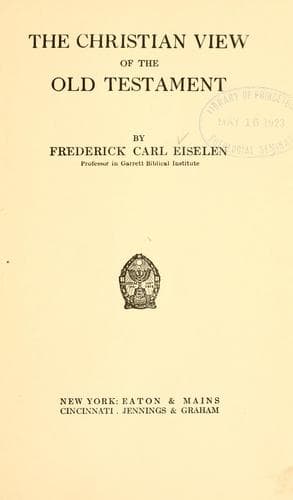
The Christian View of the Old TestamentEiselen, Frederick Carl
Religion
The Christian View of the Old Testament
Eiselen, Frederick Carl
Bible. Old Testament -- Criticism, interpretation, etc.
The book of Ecclesiastes, dealing with the perplexities of life in
general, full of pessimism and skepticism, is not without its permanent
value. The author of the book has passed through many disappointments,
and his spirit has grown somewhat skeptical and pessimistic.
Everything has proved vanity: riches, pleasure, honor, even the search
for wisdom; and he is not sure concerning his destiny after death. But
over against his experiences in life there is a faith in God who
governs the world. The book, which portrays {251} the struggle between
experience and faith, has aptly been called "a cry for light." The
author does not see the light clearly, though here and there he may
have a glimpse of it. The real perplexity is due to the fact that the
author's horizon is bounded by the grave. In this life he sees no
hope, therefore he looks with longing for a possible reckoning in an
after life; but it remains a hope and cry, it never grows into a
conviction. The more significant is the retention of his faith in God.
He is conscious of a moral order in the world, though its operation is
often frustrated; he is aware of cases in which the God-fearing man had
an advantage over others. Hence, with all his uncertainty and doubt,
he holds that it is his duty, and the duty of everyone else, to fear
God and keep his commandments; God, somehow, will care for the
mysteries and perplexities of life. Even the Song of Songs, or Song of
Solomon, often an object of ridicule, when rightly interpreted, is seen
to bring suggestive lessons to the present age. The book owes its
place in the canon of Sacred Scripture to the allegorical
interpretation given to it from the earliest times. The Jews
interpreted it as picturing the close relation existing between Jehovah
and Israel; the Christians, as picturing the intimate fellowship
between Christ and his bride, the Church. At present it is quite
generally held that this interpretation {252} does not do justice to
the primary purpose of the book; but as to its original purpose two
different views are held. According to both interpretations, the
subject of the book is love--human love; the differences of opinion are
with reference to the manner in which the subject is treated. Some
think that the book is simply a collection of love or wedding songs,
all independent of one another. Others feel that there are too many
evidences of real unity in it to permit this interpretation; they see
in the book a didactic drama or melodrama, the aim of the author being
the glorification of true human love.
Public-domain text, read in full here on John Shaqi.
Reviews
Reviews
No reviews yet
Be the first to share your thoughts on this work.
Elsewhere in the archive
Join the Discussion
Join the discussion
Sign in to leave a comment or review.
Sign InorCreate an account