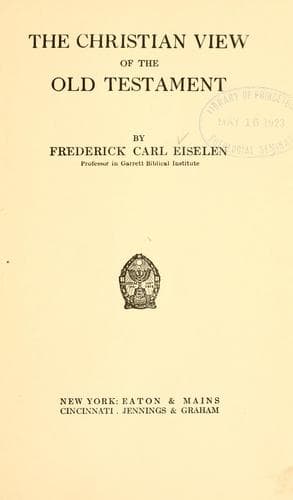
The Christian View of the Old TestamentEiselen, Frederick Carl
Religion
The Christian View of the Old Testament
Eiselen, Frederick Carl
Bible. Old Testament -- Criticism, interpretation, etc.
The drama centers around three principal characters--Solomon, the
Shunammite maiden, and her shepherd lover. The book relates how the
maiden, surprised by the king and his train, was brought to the palace
in Jerusalem, where the king hoped to win her affections and to induce
her to exchange her rustic home for the enjoyment and honor the court
life affords. She has, however, already pledged her heart to a young
shepherd; and the admiration and blandishments which the king lavishes
upon her are powerless to make her forget him. In the end she is
permitted to return to her mountain home, where at the close of the
poem the lovers appear hand in hand and express, in warm, glowing
words, the superiority of genuine spontaneous {253} affection. The
real aim of the book, therefore, seems to be to glorify true love, and
more specifically, true betrothed love, which remains steadfast even in
the most dangerous and most seductive situations.
In this age, when the responsibility of the individual Christian and of
the Christian Church toward the practical, social, religious, and moral
problems and evils is recognized more than at any other previous time,
the prophetic literature is worthy of the most careful study on the
part of all Christians who recognize and who are willing to meet their
obligations to their day and generation. The prophets of old met in
the strength of God, and at the divine impulse, the problems and evils
of their own age. They had to face the problems of materialism and
commercialism; the evils resulting from the accumulation of wealth,
power, and resources in the hands of a few; very serious economic
problems; cruelty, oppression, arrogance on the part of the rich
proprietors; corruption in government and in the administration of
justice; they had to grapple with a cold, heartless formalism that
threatened to destroy pure, spiritual religion. Against these evils
and wrongs the prophets of old raised their hands and voices. "When
the old tribal customs and bonds were weakened by the growth of cities
and the cultivation of commerce they saw that {254} society must be set
upon a moral basis or suffer destruction. When the nation itself was
about to be broken to pieces they saw in this a call for a deeper
spiritual life.... They were interested in politics, but not as a
profession in which to show their skill, or out of which they might
gain wealth or glory. Politics for them meant simply the life of the
nation in its relation to God and to the great outside world. They
were social reformers. To the earlier prophets man was regarded always
as a member of society rather than as an independent individual.... In
opposition to a showy ritual, they set up their demands for justice
between man and man."[22] Surely, it is a part of the Christian's duty
to do his share toward a Christian solution of the social and religious
problems of our day. We can hardly claim to have reached the full
Public-domain text, read in full here on John Shaqi.
Reviews
Reviews
No reviews yet
Be the first to share your thoughts on this work.
Elsewhere in the archive
Join the Discussion
Join the discussion
Sign in to leave a comment or review.
Sign InorCreate an account