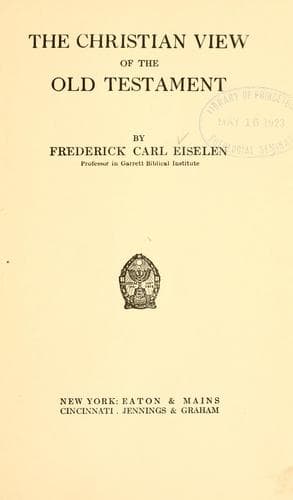
The Christian View of the Old TestamentEiselen, Frederick Carl
Religion
The Christian View of the Old Testament
Eiselen, Frederick Carl
Bible. Old Testament -- Criticism, interpretation, etc.
stature of Christian manhood or womanhood until we have acquired the
knowledge and power to cope with these difficulties in the spirit of
the Master and with the methods best adapted to the Christianizing of
modern society. In these our efforts to lift humanity nearer to God,
or to bring God nearer to humanity, we may learn much from the prophets
of old.
To sum up the results of our study: As Christians we may find our
loftiest inspiration in the study of the life, the character, and the
teachings {255} of the Master, and of the words of his disciples. But
the New Testament is little more than a quarter of the Bible. In the
preceding pages the attempt has been made to emphasize the permanent
value of the larger division of the Sacred Book. It has been carefully
scrutinized, tested in furnaces heated seven times, but out of the fire
it has come bearing the stamp of God, testifying more confidently than
ever before that God in olden times spake unto the fathers, and that in
its pages may be found records and interpretations of these
revelations. The features of the Old Testament which assure to it a
permanent place in religious thought and life may be briefly indicated
as follows:
The Old Testament will always prove attractive as literature. The more
we know of other literatures of antiquity, the more evident it becomes
that even from the literary viewpoint the Old Testament is far superior
to any other literary remains of ancient civilization. "If the
inimitable freshness of life is preserved in Homer, it is not less
preserved in the epic stories of the Old Testament; while the still
more intangible simplicity of the idyl is found perfect in Ruth and
Tobit, the orations of Deuteronomy are as noble models as the orations
of Cicero. Read by the side of the poetry of the Psalms, the lyrics of
Pindar seem almost provincial. The imaginative poetry of {256} the
Greeks is perfect in its own sphere, but by the Hebrew prophets as bold
an imagination is carried into the mysteries of the spiritual world.
If the philosophy of Plato and his successors has a special interest as
the starting point for a progression of thought still going on as
modern science, yet the field of biblical wisdom offers an attraction
of a different kind, in a progression of thought which has run its full
round and has reached a position of rest.... And in the inner circle
of the world's masterpieces, in which all kinds of literary influences
meet, the Bible has placed Job, the Isaiahan Rhapsody, ... unsurpassed
and unsurpassable."[23]
Public-domain text, read in full here on John Shaqi.
Reviews
Reviews
No reviews yet
Be the first to share your thoughts on this work.
Elsewhere in the archive
Join the Discussion
Join the discussion
Sign in to leave a comment or review.
Sign InorCreate an account