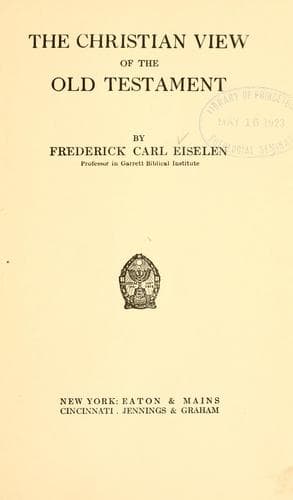
The Christian View of the Old Testament — John Shaqi
The Christian View of the Old TestamentEiselen, Frederick Carl
Religion
The Christian View of the Old Testament
Eiselen, Frederick Carl
Bible. Old Testament -- Criticism, interpretation, etc.
These are the different phases of criticism. Ordinarily, however, only
two kinds are distinguished: the lower, or textual criticism, and the
higher criticism. The aims of textual criticism are described above.
The higher criticism combines the functions of literary and historical
criticism, while linguistic criticism is considered a part of exegesis
or interpretation, not a separate branch of Bible study. The
legitimacy of textual criticism is universally recognized. Its
importance in a comprehensive study of the Bible is clearly implied in
these words of W. H. Green, a {74} generation ago the best known
defender of the traditional view of the Old Testament: "Its function is
to determine, by a careful examination of all the evidence bearing upon
the case, the condition of the sacred text, the measure of its
correspondence with, or divergence from, the exact language of the
inspired penman, and by means of all available helps to remove the
errors which may have gained admission to it from whatever cause, and
to restore the text to its pristine purity as it came from the hands of
the original writers.... It is not an arbitrary but a judicial
process, based on fixed and intelligible principles and conducted in a
determinate manner, in which all the evidence is diligently collected,
thoroughly sifted, and accurately weighed, and the decision given in
accordance with the ascertained facts."[5]
No exception is taken to linguistic criticism as a legitimate part of
exegesis, but at the mention of higher criticism many good men and
women become greatly disturbed, for they seem to look upon it as a
handmaid of Satan. A few expressions will illustrate the feeling with
which some regard this kind of study: One writer says, "Neither hard
times nor higher criticism nor infidelity ... has any effect upon the
sale of the Divine Scriptures." He evidently places higher criticism
on a par with infidelity. Again: "The so-called higher critics, it is
well known, are constantly {75} trying to shake the faith of the
Christian by telling him that the books of the Bible were not written
by the men whose names are usually given as the human authors."
Another writer declares that the higher critics allege that the Bible
is "the off-spring of incompetence and fraud." One more quotation may
suffice: "Higher criticism tends invariably ... to absolute rationalism
and the discrediting of inspiration." Now, if higher criticism is on a
par with infidelity, if it declares the Bible to be the "offspring of
incompetence and fraud," if it constantly tries to shake the faith of
Christians, if it tends invariably to absolute rationalism and
discredits inspiration--if it does these things, then the Christian
Church may well look upon it with dread and alarm. Whether or not
higher criticism is guilty of the things charged against it will
probably appear in the further discussion, for from now on chief
emphasis will be placed upon the bearing of the higher criticism on the
Public-domain text, read in full here on John Shaqi.
Reviews
Reviews
No reviews yet
Be the first to share your thoughts on this work.
Join the Discussion
Join the discussion
Sign in to leave a comment or review.
Sign InorCreate an account