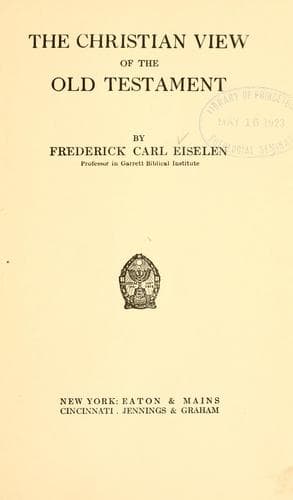
The Christian View of the Old Testament — John Shaqi
The Christian View of the Old TestamentEiselen, Frederick Carl
Religion
The Christian View of the Old Testament
Eiselen, Frederick Carl
Bible. Old Testament -- Criticism, interpretation, etc.
The legal literature differs from the other kinds in that it does not
form separate books, but is embodied in other writings, principally in
the books of Exodus, Leviticus, Numbers, and Deuteronomy. All the
representatives of Jehovah--prophets, priests, wise men, and even
psalmists--were thought competent to make known the law of Jehovah, but
the Old Testament makes it clear that at a comparatively early period
the giving of law came to be looked upon as the special duty of the
priests. These priests constituted a {19} very important class of
religious workers among the ancient Hebrews. During the greater part
of the national life their chief functions were the care of the
sanctuary and the performance of ceremonial rites. But in addition to
these duties they continued to administer the law of Jehovah,
consisting not only of ceremonial regulations but also of moral and
judicial precepts and directions. For centuries these laws may have
been transmitted by word of mouth, or were only partially committed to
writing, but when circumstances made it desirable to codify them and
put them in writing the priests would be called upon to take this
advance step. Thus, while it is quite probable that other
representatives of Jehovah helped to formulate laws, the legal
literature embodied in the Old Testament reached its final form under
priestly influence.
The historical literature furnishes an interpretation of the movements
of God in the events of history. It owes its origin in part to
prophetic, in part to priestly, activity. The prophet was an
ambassador of Jehovah appointed to make known the divine will
concerning the past, the present, and the future. Of the present he
spoke as a preacher; when his message concerned the future it took the
form of prediction; but the case might arise that the people failed to
understand the significance of events in their own history, and {20}
thus failed to appreciate the lessons which the events were intended to
teach. If these lessons were not to be lost, some one must serve as an
interpreter, and who would be better qualified to furnish the right
interpretation than the prophet? This demand made of him, in a sense,
an historian, not for the purpose of merely recording events but of
interpreting them at the same time, and these prophetic interpretations
are embodied in the historical literature originating with the prophets.
But not all Old Testament history comes from the prophets. As already
indicated, the legal and ceremonial literature is due to priestly
activity. Now, in connection with the recording of the laws, customs,
institutions, and ceremonial requirements, the origin of these laws and
customs became a matter of interest and importance. This interest, and
the demand for information arising from it, led the priests also to
become historians. And to these priestly writers we are indebted for
not a small part of sacred history.
Public-domain text, read in full here on John Shaqi.
Reviews
Reviews
No reviews yet
Be the first to share your thoughts on this work.
Join the Discussion
Join the discussion
Sign in to leave a comment or review.
Sign InorCreate an account