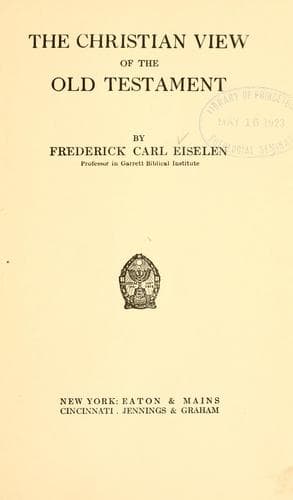
The Christian View of the Old TestamentEiselen, Frederick Carl
Religion
The Christian View of the Old Testament
Eiselen, Frederick Carl
Bible. Old Testament -- Criticism, interpretation, etc.
Similar more or less clearly marked
phenomena may {23} be noted in other Old Testament books, all of them
bearing witness to the presence of a human element in these writings.
More significant are the historical inaccuracies found here and there
in the books. They may not be serious; the substantial accuracy of the
writings may be established, but even the slightest inaccuracy
constitutes a blemish which one would not expect in a work coming
directly from an all-wise God. For example, 2 Kings 18. 10 states that
Samaria was taken in the sixth year of Hezekiah, king of Judah; verse
13 contains the statement that in the fourteenth year of Hezekiah,
Sennacherib, king of Assyria, came against Jerusalem. Now, the date of
the capture of Samaria is definitely fixed by the Assyrian
inscriptions. The city fell either in the closing days of B.C. 722, or
the beginning of B.C. 721. Assuming that it was in 722, the fourteenth
year of Hezekiah would be B.C. 714. But Sennacherib did not become
king of Assyria until B.C. 705, while his attack upon Judah and
Jerusalem was not undertaken until B.C. 701, hence there would seem to
be an inaccuracy somewhere. Certainly, since the primary purpose of
the writings is not historical, but religious, these inaccuracies do
not affect the real value of the book. Nevertheless, their presence
shows that the writings cannot be looked upon as coming in all their
parts directly from {24} God. At some point man must have stepped in
and left marks of his limitations.
Public-domain text, read in full here on John Shaqi.
Reviews
Reviews
No reviews yet
Be the first to share your thoughts on this work.
Join the Discussion
Join the discussion
Sign in to leave a comment or review.
Sign InorCreate an account