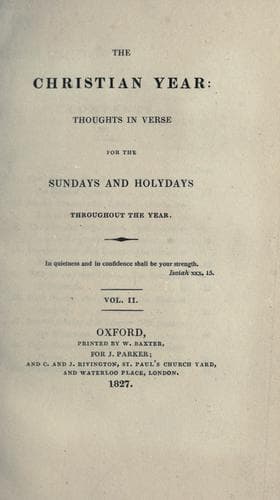
Christian poetry, English -- 19th century; Church year -- Poetry; Hymns, English
Soft as Memnon’s harp at morning,
To the inward ear devout,
Touched by light, with heavenly warning
Your transporting chords ring out.
Every leaf in every nook,
Every wave in every brook,
Chanting with a solemn voice,
Minds us of our better choice.
Needs no show of mountain hoary,
Winding shore or deepening glen,
Where the landscape in its glory
Teaches truth to wandering men:
Give true hearts but earth and sky,
And some flowers to bloom and die,
Homely scenes and simple views
Lowly thoughts may best infuse.
See the soft green willow springing
Where the waters gently pass,
Every way her free arms flinging
O’er the moist and reedy grass.
Long ere winter blasts are fled,
See her tipped with vernal red,
And her kindly flower displayed
Ere her leaf can cast a shade.
Though the rudest hand assail her,
Patiently she droops awhile,
But when showers and breezes hail her,
Wears again her willing smile.
Thus I learn Contentment’s power
From the slighted willow bower,
Ready to give thanks and live
On the least that Heaven may give.
If, the quiet brooklet leaving,
Up the stony vale I wind,
Haply half in fancy grieving
For the shades I leave behind,
By the dusty wayside drear,
Nightingales with joyous cheer
Sing, my sadness to reprove,
Gladlier than in cultured grove.
Where the thickest boughs are twining
Of the greenest darkest tree,
There they plunge, the light declining—
All may hear, but none may see.
Fearless of the passing hoof,
Hardly will they fleet aloof;
So they live in modest ways,
Trust entire, and ceaseless praise.
Second Sunday after Epiphany.
Every man at the beginning doth set forth good wine: and when men
have well drunk, then that which is worse; but thou hast kept the
good wine until now. _St. John_ ii. 10.
THE heart of childhood is all mirth:
We frolic to and fro
As free and blithe, as if on earth
Were no such thing as woe.
But if indeed with reckless faith
We trust the flattering voice,
Which whispers, “Take thy fill ere death,
Indulge thee and rejoice;”
Too surely, every setting day,
Some lost delight we mourn;
The flowers all die along our way
Till we, too, die forlorn.
Such is the world’s gay garish feast,
In her first charming bowl
Infusing all that fires the breast,
And cheats the unstable soul.
And still, as loud the revel swells,
The fevered pulse beats higher,
Till the seared taste from foulest wells
Is fain to slake its fire.
Unlike the feast of heavenly love
Spread at the Saviour’s word
For souls that hear His call, and prove
Meet for His bridal board.
Why should we fear, youth’s draught of joy
If pure would sparkle less?
Why should the cup the sooner cloy,
Which God hath deigned to bless?
Public-domain text, read in full here on John Shaqi.
Reviews
Reviews
No reviews yet
Be the first to share your thoughts on this work.
Join the Discussion
Join the discussion
Sign in to leave a comment or review.
Sign InorCreate an account