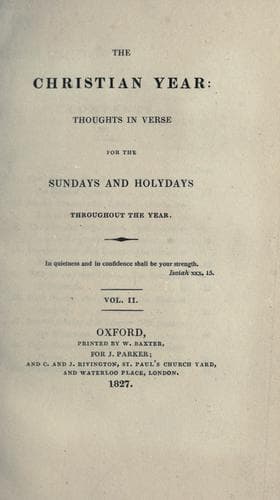
Christian poetry, English -- 19th century; Church year -- Poetry; Hymns, English
Ah! ’tis the world enthralls
The Heaven-betrothèd breast:
The traitor Sense recalls
The soaring soul from rest.
That bitter sigh was all for earth,
For glories gone and vanished mirth.
Age would to youth return,
Farther from Heaven would be,
To feel the wildfire burn,
On idolising knee
Again to fall, and rob Thy shrine
Of hearts, the right of Love Divine.
Lord of this erring flock!
Thou whose soft showers distil
On ocean waste or rock,
Free as on Hermon hill,
Do Thou our craven spirits cheer,
And shame away the selfish tear.
’Twas silent all and dead
Beside the barren sea,
Where Philip’s steps were led,
Led by a voice from Thee—
He rose and went, nor asked Thee why,
Nor stayed to heave one faithless sigh:
Upon his lonely way
The high-born traveller came,
Reading a mournful lay
Of “One who bore our shame,
Silent Himself, His name untold,
And yet His glories were of old.”
To muse what Heaven might mean
His wondering brow he raised,
And met an eye serene
That on him watchful gazed.
No Hermit e’er so welcome crossed
A child’s lone path in woodland lost.
Now wonder turns to love;
The scrolls of sacred lore
No darksome mazes prove;
The desert tires no more
They bathe where holy waters flow,
Then on their way rejoicing go.
They part to meet in Heaven;
But of the joy they share,
Absolving and forgiven,
The sweet remembrance bear.
Yes—mark him well, ye cold and proud.
Bewildered in a heartless crowd,
Starting and turning pale
At Rumour’s angry din—
No storm can now assail
The charm he wears within,
Rejoicing still, and doing good,
And with the thought of God imbued.
No glare of high estate,
No gloom of woe or want,
The radiance can abate
Where Heaven delights to haunt:
Sin only bides the genial ray,
And, round the Cross, makes night of day.
Then weep it from thy heart;
So mayst thou duly learn
The intercessor’s part;
Thy prayers and tears may earn
For fallen souls some healing breath,
Era they have died the Apostate’s death.
Sixth Sunday after Epiphany.
Beloved, now are we the sons of God, and it doth not yet appear what
we shall be: but we know that, when He shall appear, we shall be like
Him; for we shall see Him as he is. _St. John_ iii. 2.
THERE are, who darkling and alone,
Would wish the weary night were gone,
Though dawning morn should only show
The secret of their unknown woe:
Who pray for sharpest throbs of pain
To ease them of doubt’s galling chain:
“Only disperse the cloud,” they cry,
“And if our fate be death, give light and let us die.”
Public-domain text, read in full here on John Shaqi.
Reviews
Reviews
No reviews yet
Be the first to share your thoughts on this work.
Join the Discussion
Join the discussion
Sign in to leave a comment or review.
Sign InorCreate an account