Transcriber's Note: Footnotes have been renumbered and moved to the end
of the book.
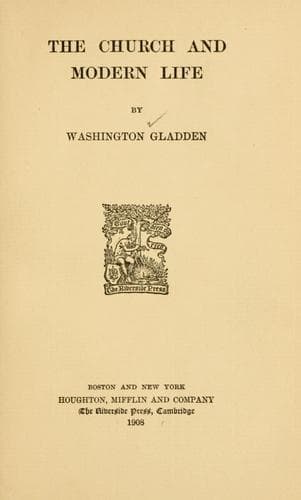
The Church and Modern Life
By
Washington Gladden
1908
Preface
"The time is come," said a New Testament prophet, "for judgment to begin
at the house of God." Perhaps that time ought never to pass, but if, in
any measure, the criticism of the church has of late been suspended, it
is certainly reopened now, in good earnest. Nor is this criticism
confined to outsiders; the church is forced to listen in these days to
caustic censures from those who speak from within the fold.
That such self-criticism is needed these chapters will not deny. That
the church is passing through a critical period must be conceded. But
the way of life is not obscure, and it seems almost absurd to indulge
the fear that the church, which has been providentially guided through
so many centuries, will fail to find it.
These pages have been written in the firm belief that the Christian
church has its great work still before it, and that it only needs to
free itself from its entanglements and gird itself for its testimony to
become the light of the world. Something of what it needs to do to make
ready for this great future, this little book tries to show.
Through all this study the thought has constantly returned to the young
men and women to whom the future of the church is committed; and while
the book is most likely first to fall into the hands of their pastors
and teachers, the author hopes that ways will be found of conveying its
message to those by whom, in the end, its truth will be made effective.
W. G.
First Congregational Church,
Columbus, Ohio, December 17, 1907.
Contents
I. The Roots of Religion
II. Our Religion and Other Religions
III. The Social Side of Religion
IV. The Business of the Church
V. Is the Church Decadent?
VI. The Coming Reformation
VII. Social Redemption
VIII. The New Evangelism
IX. The New Leadership
The Church and Modern Life
I
The Roots of Religion
The church with which we are to deal in the pages which follow is the
Christian church in the United States, comprising the entire body of
Christian disciples who are organized into religious societies, and are
engaged in Christian work and worship.
This church is not all included in one organization; it is made up of
many different sects and denominations, some of which have very little
fellowship with the rest. Among these groups are some who claim that
their particular organizations are the true and only churches; that the
others have no right to the name. Such is the claim of the Roman
Catholic church and of the High Church Episcopalians. Their use of the
word church would confine it to those of their own communions. Others
would apply the term more broadly to all who _profess and call_
themselves Christians, and who are united in promoting the teachings
and principles of the Christian religion.
Public-domain text, read in full here on John Shaqi.
Reviews
Reviews
No reviews yet
Be the first to share your thoughts on this work.
Join the Discussion
Join the discussion
Sign in to leave a comment or review.
Sign InorCreate an account