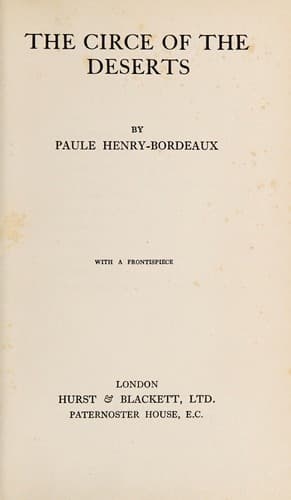
Middle East -- Description and travel; Stanhope, Hester, Lady, 1776-1839
Anthony lost his prestige; that of Lady Hester increased in
proportion.
Tripoli, where Lady Hester occupied, for several months, an uninhabited
convent of the Capuchins, had as military governor Mustafa Aga Barbar.
Of very low origin, the son of a muleteer, he had, at the head of a band
of resolute fellows, captured the fortress of the town by surprise. The
people, who detested the janissaries, had risen in revolt with him, and
a firman of the Porte confirmed him in the post which he had usurped,
for in the East the strongest reason is always the best. He received
Lady Hester with a homely simplicity which contrasted with the stiff
politeness of the Turks. She made on him a lasting impression.
In January 1815, Lady Hester returned to Mar-Elias. Scarcely had she
alighted from her donkey than she received horrible news, brought back
from Bairout by Beaudin: a Capugi Bachi had arrived, demanding her with
hue and cry! Everyone knows that a Capugi Bachi does not come into a
province except to give orders for strangulation, hanging, imprisonment
and the bastinado, never for an agreeable object. Lady Hester smiled
slyly and sent a pressing message to the Capugi Bachi, who arrived at
the end of dinner. Beaudin and Meryon, who had decorated their girdles
with pistols, regarded with a hostile eye this little man who came to
disturb their digestion. They were far from expecting the reality.
An attack of plague would have sufficed as occupation to the average
woman; nevertheless, it was during her illness that Lady Hester drew up
a plan of campaign around an old manuscript which had fallen by chance
into her hands, and which indicated the site where fabulous riches had
been concealed in the ruins of Sidon and Ascalon. Treasures? Nothing was
impossible. In the East the inhabitants possess no certainty of
preserving their property. Deprived of banks, deprived of paper-money
easy to handle, subject to the arbitrary will of avaricious governors,
living in the midst of perpetual wars and troubles--in twenty years
Tripoli had been besieged five times and five times sacked--they have
only one resource: a good and mysterious hiding-place, unknown to all
and particularly to their women.
Moreover, the people divided European travellers into three categories:
exiles, spies and treasure-seekers. Lady Hester strongly suspected the
Porte of laying a trap for her, but it was too dangerous to place
herself in the first categories of foreigners, and she played the part
of one who believed in the manuscript. A little time afterwards, she was
to believe in it in reality and blindly.
Public-domain text, read in full here on John Shaqi.
Reviews
Reviews
No reviews yet
Be the first to share your thoughts on this work.
Elsewhere in the archive
Join the Discussion
Join the discussion
Sign in to leave a comment or review.
Sign InorCreate an account