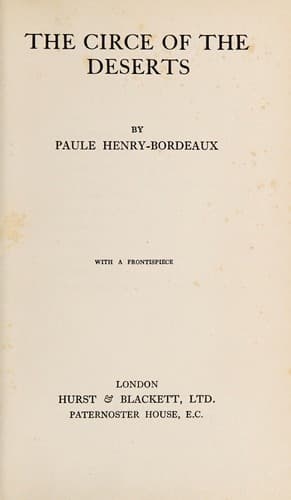
Middle East -- Description and travel; Stanhope, Hester, Lady, 1776-1839
And in the evening they encamped on the margin of springs, sometimes in
one of those sanctuaries dedicated to some unknown Mohammedan saint
which the commercial sense of the Arabs has transformed into a café.
Such was that of Kludder. The history of the occupier is too significant
not to be related. This worthy son of Allah had a wife, old and of
canonical appearance, who carried on the business admirably. He
preferred to her a young and pretty girl, who, however, understood
nothing about business. He therefore recalled the first and kept them
both, joining thus the useful to the agreeable. For five years they
shared the task of enriching him and amusing him.
Sidon was sleeping in its orchards of orange-trees when the travellers
stopped at the entrance to the town. Between its two castles in ruins,
of which one is expiring to the rhythm of the waves, it seemed a
princess of "The Thousand and One Nights" guarded by two black giants.
But the arches of the prison were infinite, and lamps of gold watched
over her slumber.
Lady Hester and her people were lodged at the French caravanserai,
prepared by the diligent attentions of the French consul, M. Taitbout.
Scarcely were they installed there than an invitation arrived from the
Prince of the Druses, the Emir Bechir, accompanied by twelve camels,
twenty-five mules, four horses and seven foot soldiers. The two sons of
a merchant of Sidon, the brothers Bertrand, half-dragomans,
half-doctors, were joined to the expedition. They had the quality of
being interchangeable, and travellers never knew exactly with which they
had to deal.
Rather unpleasant rumours were in circulation at Sidon in regard to the
emir. He was born of Moslem parents, but practised in secret the
Christian religion. He was a tyrant, said some, a hypocrite, said
others. Worthy emulator of Djezzar, had he not just caused the eyes of
his nephews, the sons of the Emir Yusef, to be torn out, because they
ventured to compromise his power? He had had a magnificent palace built
in the heart of the Lebanon. And, whispered the best informed people,
there was in the great hall of Beit-ed-Din, a ceiling of such beauty
that the delighted emir had, by way of recompense, caused the two hands
of the artist to be cut off, in order that he might never be able to
begin another. A protector of the arts rather out of the common!
By a narrow path which embraced the circuit of the Nahr-el-Damour,
Bechir's escort guided Lady Hester towards Deir-el-Kammar (the convent
of the moon), which they reached at nightfall. In the morning they had
an elating spectacle: dominating the bounding waters of the torrent,
clinging to the flanks of the mountain, the palace stretched towards the
sun, raising its flowering roofs, its white terraces, its towers, its
arcades, its gardens, which fell back as though in despair at not having
been able to kiss the sky and descended exhausted to the foot of the
slope.
The doctor noted down briefly on his tablets:
Public-domain text, read in full here on John Shaqi.
Reviews
Reviews
No reviews yet
Be the first to share your thoughts on this work.
Join the Discussion
Join the discussion
Sign in to leave a comment or review.
Sign InorCreate an account