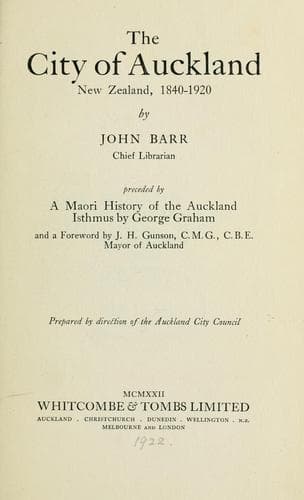
The City of Auckland, New Zealand, 1840-1920 — John Shaqi
The City of Auckland, New Zealand, 1840-1920Barr, John
History
The City of Auckland, New Zealand, 1840-1920
Barr, John
Auckland (N.Z.) -- History
Thereafter occurred the affair of Kapetawa. When a mere lad, this
chief, while on a visit from Waiheke to his sister, who had married
Taramokomoko, a chieftain of Kohimarama, got into several scrapes,
as boys were much the same then as ever, but when he, as the
ringleader with kindred spirits, plundered the kumara store of his
brother-in-law, he got into disfavour with Taramokomoko, who marooned
him on the Bean Rock off the shore. Being rescued by his sister, he
returned home, where he grew to manhood among his own people, the
Ngati-Paoa, at Waiheke. He then organised a war party to avenge the
long-remembered insult. Surprising the pas at Kohimarama, Orakei, etc.,
he crossed to Takapuna, destroying several villages there and along
the outer coast, where the erring brother-in-law, the cause of all
this trouble, was caught and killed at Raho-para--a pa on the northern
headland of the Wairau Creek (Milford).
X
_Kiwi Tamaki (1720-1750)_
We now come to the era of Kiwi Tamaki, the last, and undoubtedly
the most notorious, of the olden Tamaki chiefs. He was so called to
distinguish him from other men of that name.
His parents, Te Ikamaupoho and Te Tahuri, united in their ancestry
all that was aristocratic in lineal descent from the ancient
Patu-paiarehe, Nga-Oho (People of Toi), Ngati-Awa, Arawa, Tainui, etc.
Despite the many repeated invasions and incessant warfare within their
territories, the Tamaki people at this time were apparently in their
"golden age."
The family home was the citadel of One Tree Hill. The mother, Te
Tahuri, was renowned for her hospitality and industry. The resources
of the district and the extent of the fortifications and cultivation
were famous far and near. On the Manukau and Waitemata, large fleets of
canoes for fishing and war purposes were maintained. Hence the proverb
"Te pai me te whai-rawa o Tamaki"--the luxury and wealth of Tamaki.
The many previously described wars had ere this earned for the Isthmus
the appropriate motto "Tamaki-makau-Rau" (_i.e._, The spouse contested
for us by a hundred lovers).
Public-domain text, read in full here on John Shaqi.
Reviews
Reviews
No reviews yet
Be the first to share your thoughts on this work.
Join the Discussion
Join the discussion
Sign in to leave a comment or review.
Sign InorCreate an account