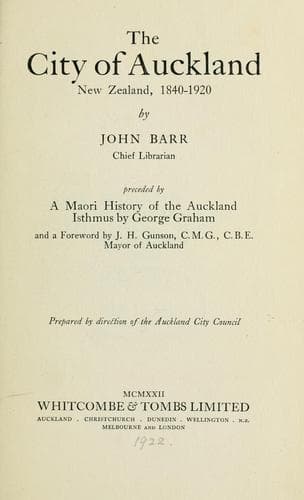
The City of Auckland, New Zealand, 1840-1920Barr, John
History
The City of Auckland, New Zealand, 1840-1920
Barr, John
Auckland (N.Z.) -- History
Ngati-Whatua were now installed in possession of Tamaki. They soon
found that might was the only right to their new territory. To the
south were the powerful Waikato and Marutuahu tribes, who by sea and
land were a continual anxiety to the new lords of Tamaki. They were
closely related to the late victims of Ngati-Whatua. Many of the
refugees, indeed, had gone to those districts to live, and no doubt
instigated many a surprise attack. Ngati-Paoa appear to have always
maintained several fortified villages on the Tamaki River unmolested by
Ngati-Whatua down to European times.
Quarrels arose with Ngati-Paoa at last as the result of a marriage of
a Waikato chieftainess to Te Putu, a Ngati-Paoa chief. Land on the
Tamaki River had been given to cement a tribal peace and in honour of
the union. Shortly thereafter, at a fishing expedition off Mahurangi,
Ngati-Paoa and Ngati-Whatua quarrelled. The former attacked the latter
and killed Tara-hawaiki, son of Tuperiri. Ngati-Paoa followed this up
by invading Tamaki, having in alliance with them the other Hauraki
tribes. The invaders were defeated by Ngati-Whatua at Pu-ponga on the
Manukau Harbour and again at Rangi-mata-rau (Point Chevalier Beach).
On a later occasion a party of Ngati-Paoa were surprised whilst
shark-fishing at Kauri Point,[2] the survivors being left on the
pinnacle rock (Niho-Kiore) off there to drown.
Thereafter Ngati-Whatua, now in alliance with Waikato and Manukau
tribes, attacked Ngati-Paoa at Putiki (Waiheke). In a final battle at
Tamaki West Heads, Ngati-Paoa were defeated, and thus was ended that
warfare. This event is placed about 1793, and permanently established
Ngati-Whatua's prestige and their possession of Tamaki.
At this time, Tamaki had become a rather unsafe place of residence, and
does not appear to have been extensively occupied. In fact, Mount Eden
and many of the large hill forts had long been abandoned, and their
elaborate defences were already in ruin and overgrown with scrub and
fern.
About this period, also, came a great epidemic remembered as the
"Rewharewha." It was probably an influenza outbreak, and swept
throughout the land. No doubt this visitation further reduced the
Tamaki population, and therein lies the reason why many of the old-time
villages were abandoned and passed out of history. The remnants of
the people, though still numerous, were unable to hold the large hill
fortresses against an enemy. Smaller and easier defended positions only
were maintained.
Public-domain text, read in full here on John Shaqi.
Reviews
Reviews
No reviews yet
Be the first to share your thoughts on this work.
Join the Discussion
Join the discussion
Sign in to leave a comment or review.
Sign InorCreate an account