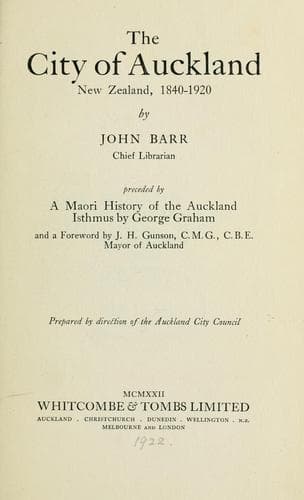
The City of Auckland, New Zealand, 1840-1920Barr, John
History
The City of Auckland, New Zealand, 1840-1920
Barr, John
Auckland (N.Z.) -- History
In 1843, the first conflict with the Maoris took place at Wairau,
and in the following year Hone Heke's rebellion began. These events
are outside the scope of this sketch, except in so far as they react
upon the city's history. The destruction of Kororareka by Heke's
followers caused many of the settlers to come to Auckland, and created
consternation and panic in the town itself. It was feared that
the rebels would follow up their success in the Bay of Islands by
attacking the capital. The defences of the barracks were improved, and
entrenchments made, while the citizens were prepared for eventualities
by being drilled. As it happened, the tide of war swept northward, and
did not reach the city. The consequence, however, as far as the capital
was concerned, was to retard its progress. We do not need to enter into
the details of the war, except to anticipate its results. Governor
Fitzroy's conduct of the crisis was unsatisfactory. He was recalled,
and his successor, Captain George Grey,[18] arrived in Auckland on
14th November, 1845, and took steps which speedily ended the war in the
north. As Governor of New Zealand and citizen of Auckland, he did much
for both. He was twice Governor (1845-53 and 1861-68), Superintendent
of the Auckland Province, 1875, and he is the only Governor who
subsequently became a member of Parliament and Premier of the Colony
over which he formerly governed. The greater part of his official and
private life is associated with this city. On his retirement from the
governorship, at the expiration of his second term, he acquired the
island of Kawau, and there made his home. From then until 1894 he was
closely identified with Auckland's development, and it may be taken
for granted that he held the former capital in high esteem when he
chose to bequeath to it his collection of rare and valuable books and
manuscripts, as well as his pictures and an ethnological collection of
no little value. He is to be ranked as one of Auckland's makers and
benefactors. A statue erected to perpetuate his memory stands near the
Town Hall. It was unveiled on December 21st, 1904, by the Governor,
Lord Plunket. Mr. W. J. Speight, who was chairman of the Memorial
Committee, presided at the ceremony.
Public-domain text, read in full here on John Shaqi.
Reviews
Reviews
No reviews yet
Be the first to share your thoughts on this work.
Join the Discussion
Join the discussion
Sign in to leave a comment or review.
Sign InorCreate an account