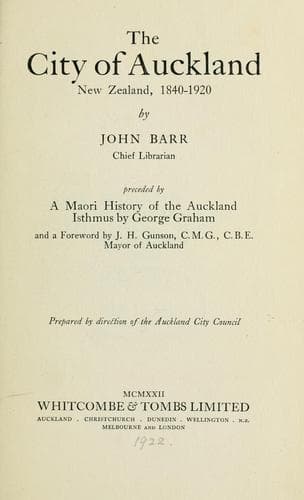
The City of Auckland, New Zealand, 1840-1920Barr, John
History
The City of Auckland, New Zealand, 1840-1920
Barr, John
Auckland (N.Z.) -- History
The earliest fire of importance recorded in Auckland was that which
destroyed Government House in June, 1848. The building was constructed
of wood, which was brought out in sections from England, and in
appearance resembled an ordinary cottage. Fortunately, a sketch by
Baron de Thierry survives, and is preserved in the Auckland Old
Colonists' Museum. The destroyed building occupied a site within the
grounds of the present Government House property.
[Illustration: Auckland, 1852, from Queen Street Wharf
Showing Queen Street and corner of Shortland Street, the Wesleyan
College (now the People's Palace) and the Windmill, Karangahape Road,
still a city landmark. (The two uniformed men in the foreground are
native policemen)
_P. J. Hogan, delt._]
Chapter II
_Development: 1851-1870_
The advent of the second decade of Auckland's history finds the town
passing from the cradle stage to one of more independence. Until the
year 1851 Auckland had been variously described as "the town," "the
seat of government," or "the capital." In other words, it had been
fostered by the Government. Now, by a Proclamation of the Governor,
Sir George Grey, it was elevated to the position of a borough, with a
corporation--the first to be created in New Zealand--to which was given
the powers of self-government on all matters of local interest. The
elections were held on November 18th, and resulted in the return of
the following gentlemen:--Messrs. Edwin Davy, Archibald Clark, Patrick
Dignan, F. W. Merriman, A. B. Abraham, James O'Neill, S. Norman, T. M.
Haultain, J. A. Hickson, A. Macdonald, Joseph Newman, William Powditch,
William I. Taylor, and W. Mason. On November 25th the councillors
were sworn in, the event taking place at the Court House, Auckland,
before the Chief Justice (Sir William Martin), and in the presence of
Lieutenant-Governor Wynyard and the naval, military and civil officers
of the Government, as well as the officers of the 58th Regiment, the
clergy, a numerous assemblage of ladies and a great concourse of
burgesses, the day being observed as a special public holiday in honour
of the occasion. To the accompaniment of a flourish of bugles the names
of the gentlemen chosen to be first Mayor and aldermen of Auckland were
announced as follows:--Mayor, Mr. Clark; aldermen, Messrs. Dignan,
O'Neill, Powditch and Mason. Thereafter the Charter of Incorporation
was read, and the Lieutenant-Governor delivered an address, in which
he stated to the councillors that "it cannot fail to be a matter of
gratifying personal distinction to yourselves to be selected from
upwards of fourteen hundred burgesses to fill the office and discharge
the duties of the first Council of the first Corporation established
in this country, under the immediate sanction of the Royal authority."
The ceremony ended with the guard of honour presenting arms, while the
band played the National Anthem, and a salute of twelve guns from the
battery at Fort Britomart was fired.
Public-domain text, read in full here on John Shaqi.
Reviews
Reviews
No reviews yet
Be the first to share your thoughts on this work.
Join the Discussion
Join the discussion
Sign in to leave a comment or review.
Sign InorCreate an account