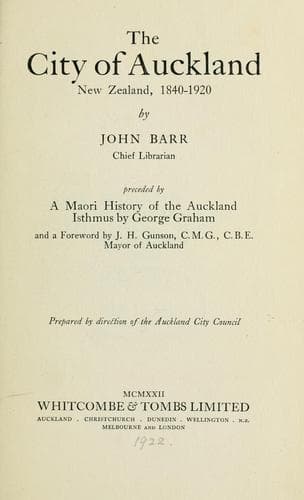
The City of Auckland, New Zealand, 1840-1920Barr, John
History
The City of Auckland, New Zealand, 1840-1920
Barr, John
Auckland (N.Z.) -- History
The effects of the war were felt in Auckland in various ways. At first
there was confusion and consternation among the inhabitants, which
feelings were allayed by the arrival of troops and the passing of the
danger of invasion. Notwithstanding the business and commerce of the
city continued to increase. At the conclusion of the war a reaction
set in, and distress through unemployment became acute, especially
among newly-arrived immigrants. The population of the city at the
census taken in December, 1861, was 7989 persons, and three years
later had grown to 12,423, a very large increase in so short a time.
The rush to the Otago goldfields, however, began to draw numbers of
the population south, and the removal of the seat of Government, in
1865, was responsible for the loss of the Government officers and civil
servants. During the two following years, 1866 and 1867, most of the
Imperial regiments which had taken part in the Maori wars returned to
England, taking with them their wives and families, further reducing
the population. The last of the troops to leave Auckland was the 18th
(Royal Irish) Regiment, which departed at the beginning of 1870. The
survivors of this regiment hold a reunion annually in Auckland on
July 4th, the anniversary of their arrival in New Zealand. By 1867
the inhabitants had decreased to 11,153. Auckland was passing through
a bad period, while its rival on the Cook Straits, and Dunedin and
Christchurch were progressing rapidly.
The record of the banks which opened business in this period shows
clearly the progress which the city was making. In 1861 two new banks
began operations. The Bank of New South Wales was opened in Shortland
Street on 11th June, and continued to carry on the business of the
branch of the Oriental Bank Corporation, which had been established in
the city some years previously. On February 21st, 1884, the building in
Queen Street was opened, where the business is still carried on. The
architects were Messrs. Armson, Collins and Lloyd, of Christchurch, and
the contractor Mr. Philcox, of Auckland. The building cost £11,500.
The Bank of New Zealand, an entirely local concern, commenced business
on 16th October. A contemporary newspaper emphasised this aspect, and
stated that the business was being conducted "with colonial capital,
with colonial shareholders ... and with colonial customers in every
city and province of New Zealand vitally interested in its success."
The initial capital was £500,000. Mr. A. Kennedy, formerly manager of
the New Zealand Banking Company and of the Union Bank of Australia, was
its first manager. The original premises were in Queen Street, near
Durham Street East, formerly occupied by T. S. Forsaith. The building
now used was opened towards the end of 1867, and ranks as one of the
finest examples of architecture in the city. The architect was Mr.
Leonard Terry, of Melbourne, and the builder was Mr. R. Dickson. Mr.
Richard Keals was supervising architect.
Public-domain text, read in full here on John Shaqi.
Reviews
Reviews
No reviews yet
Be the first to share your thoughts on this work.
Join the Discussion
Join the discussion
Sign in to leave a comment or review.
Sign InorCreate an account