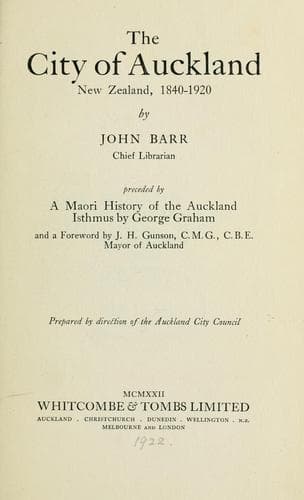
The City of Auckland, New Zealand, 1840-1920Barr, John
History
The City of Auckland, New Zealand, 1840-1920
Barr, John
Auckland (N.Z.) -- History
Then, again, there was an equally ancient, but more human-like people
resident hereabouts--the "Patu-paiarehe"--so-called "Fairies," from
whom, indeed, many of the leading chieftains of to-day proudly claim
descent. Concerning these people we are told of their industry in the
arts of peace, fishing, hunting, weaving, etc.; nor were they, it would
seem, deficient in the sterner art of war, for they were involved in
much inter-tribal strife. One of these struggles resulted in a weaker
faction deciding to emigrate across the Waitemata. In order to do so
they began to erect a stone causeway. However, the sun arose on their
uncompleted toil, and dried them all up! The ruin of this ancient
attempt to bridge the Waitemata remains to this day in the form of
that long reef "Te Toka-roa," off Point Chevalier. The unsentimental
geologist will tell you it is actually an old lava flow from Mount
Albert.
Despite the mists of legendary lore which surround the doings of these
ancient people, both "Giants" and "Fairies," it is probable that they
had actually existed here. They were, perhaps, the earliest of the
immigratory races which were continually arriving. Over the Pacific
Ocean canoe voyages were taking place in all directions. The motive
which impelled these undertakings was doubtless that stated in the
legends--overpopulation involving warfare, causing the weaker factions
to seek safer homes over the water to live in. No doubt the food
supplies of over-populated islands also necessitated sections of the
people to swarm off; the mere spirit of adventure, ever in the human
heart, was probably an important contributory cause.
Whoever these ancient people were--and the probability is that they
were Polynesians similar to the immigrants of a later time--they
were a numerous people who "covered the land like ants"; such is the
proverbial description of them.
II
_Toi-te-huatahi_[1]
Some time about 1150 A.D. there arrived in New Zealand a chief named
Toi-te-huatahi, the leader of a large immigration, who settled at
Whakatane, and his people, known as Te Tini-o-Toi, rapidly spread
throughout the land, conquering or merging with their predecessors.
Tamaki was soon populated by them. Oho-mai-Rangi, said to be a son of
Toi, lived at the Waikato Heads, and to him is generally attributed the
tribal name "Nga-Oho"--a people of Toi who occupied a wide area in the
south, Waikato and Tamaki. A great-grandson of Toi was one Kauea, who
carried the conquests of his people into the Kaipara and the far north.
By the middle of the fourteenth century we find the Nga-Oho dominant
over all this area, having various sub-tribal names, such as the
Nga-riki, Wai-o-hua, etc.
III
_The Arrival of the Fleet_--_1350 A.D._
About 1350 A.D. came another wave of immigrants from Polynesia--for
then arrived the historic fleet of canoes, the Arawa, Tainui, Matatua,
and others.
Public-domain text, read in full here on John Shaqi.
Reviews
Reviews
No reviews yet
Be the first to share your thoughts on this work.
Join the Discussion
Join the discussion
Sign in to leave a comment or review.
Sign InorCreate an account