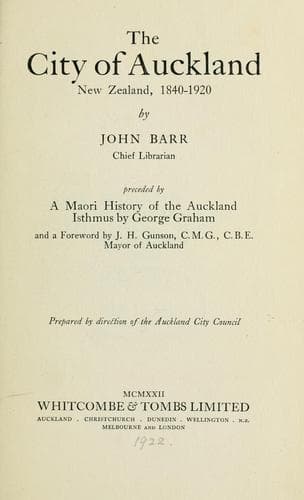
The City of Auckland, New Zealand, 1840-1920Barr, John
History
The City of Auckland, New Zealand, 1840-1920
Barr, John
Auckland (N.Z.) -- History
To the west of Queen Street the reclaimed area can be easily
distinguished on account of the regular low-lying nature of the streets
comprised within it. If one follows a route from Queen Street along
Customs, Sturdee, Fanshawe, Halsey, Patteson and Beaumont Streets,
where the last named street junctions with Fanshawe Street, this would
give roughly the foreshore as it existed in 1870. The reclamations,
which include the area now occupied by Victoria Park, were completed
about 1900.
The Harbour Board is still engaged upon reclamation work, adding
considerably to the city and port's facilities.
The wharves did not alter much during the first thirty years of the
Board's control. In this period the Queen Street Wharf was practically
rebuilt and considerably enlarged, and the Railway Wharf erected. At
a later date, Hobson Street Wharf, the Quay Street Jetty and other
jetties were built. In the 'eighties Gore Street Wharf was demolished
in connection with the Quay Street reclamations, and extra wharf
provision was made parallel to this street. All these wharves were
constructed of wood. In 1900 the comprehensive scheme of wharves in
concrete was commenced, and has been steadily pushed forward. At the
present time the port's wharves are a credit to the authorities, alike
in size, number and equipment, and, although the accommodation for
ships has been greatly increased, the Board is occupied with further
extensions, to enable it to keep pace with the growth of the port's
shipping.
Docking accommodation for the repair of vessels was also put in hand by
the Harbour Board. On May 1st, 1876, the Auckland Graving Dock, which
was situated opposite Hobson Street, was commenced, and was opened
on August 20th, 1878. This dock was used for small vessels. It was
abandoned in 1913 and the site filled in.
The Calliope Dock, on the North Shore, was opened by the Governor (Sir
William F. D. Jervois) on February 16th, 1888, in the presence of
Admiral Fairfax, commander of the fleet on the Australasian station.
The day was made the occasion of a public holiday. Bunting was to be
seen everywhere: in the city, at Devonport, and on the vessels in
the harbour. Two of her Majesty's ships of war, the _Calliope_ and
_Diamond_, steamed into the new dock, the former cutting the ribbon
stretched across. The dock was, when opened, the largest graving dock
possessed by any colony, and had cost up to that date £135,000. It
required an additional expenditure of £20,000 to make it as complete as
possible. Mr. Pierce Lanigan was the contractor, Mr. W. Errington the
engineer, and Mr. Swainson clerk of works.
H.M.S. _Calliope_, which, as has been mentioned, was the first vessel
to enter the dock, became famous in the annals of seamanship only a
month later, when, during the great storm of 16th March, 1888, which
struck Samoa, she sailed out from Apia under the command of Captain
Kane. All the vessels which remained in the harbour were wrecked.
Public-domain text, read in full here on John Shaqi.
Reviews
Reviews
No reviews yet
Be the first to share your thoughts on this work.
Elsewhere in the archive
Join the Discussion
Join the discussion
Sign in to leave a comment or review.
Sign InorCreate an account