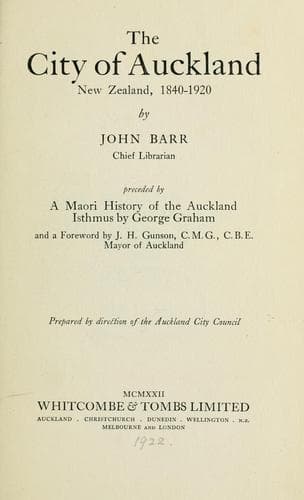
The City of Auckland, New Zealand, 1840-1920Barr, John
History
The City of Auckland, New Zealand, 1840-1920
Barr, John
Auckland (N.Z.) -- History
Auckland has always been a fortunate city in respect to benefactors,
some of whom have been already noticed. Two others must be
mentioned here. Mr. Edward Costley, who died on April 18th, 1883,
bequeathed the sum of £84,700 in equal shares to the following city
institutions:--Institute and Museum, Public Library, Hospital, Orphan
Home, Costley Home for the Aged Poor, Sailors' Home, and Boys'
Institute. Mr. James Dilworth, the other benefactor, died on December
23rd, 1894, leaving estate valued at £100,000, to be applied to the
maintenance and education of orphans or of children of persons of good
character and in straitened circumstances, the education to extend to
secondary schools and the university if the children show fitness for
such.
The Jubilee Institute for the Blind was founded on July 9th, 1890.
The present site was purchased in 1891, and a dwelling which stood on
it was renovated and opened as a school. As the pupils increased,
additions were made, including a workshop for blind men. Early in the
history of the Institute a building fund had been inaugurated, with the
view of erecting a permanent building. The bequest of £10,000 of Mr.
Wm. Mason, who died in 1905, and the energy of Mr. John Abbott, enabled
the trustees to realise their hopes earlier than otherwise would have
been possible. The foundation stone of the new building was laid by the
Hon. Geo. Fowlds, Minister for Education, in May, 1907, and on the 21st
May, 1909, the building was officially opened by the Governor, Lord
Plunket. Mr. E. Bartley was the architect, and Messrs. Philcox and Son
the contractors, the cost of the building being £13,735.
The Diamond Jubilee of Queen Victoria was celebrated in Auckland on
June 22nd, 1897, and during the following week. For the occasion the
city was elaborately decorated, every building and vantage point being
utilised, and at night, illuminations, bonfires and fireworks were
to be seen everywhere. Both decorations and illuminations surpassed
anything of the kind ever previously attempted in Auckland. The formal
celebrations comprised a magnificent procession, in which the navy, the
army, the corporations of the city and suburban districts, the Harbour
Board and other institutions took part, as well as the children of the
public schools. The vehicles taking part were gaily decorated, and
banners were conspicuous. The procession travelled from Queen Street to
the Domain, where 20,000 people were congregated. Mr. P. Dignan, Mayor,
delivered an address, and concluded by asking the school children,
numbering about 2,000, to sing the National Anthem. The military part
of the proceedings consisted of the firing of a Royal salute, a review
and a march past, under the command of Lieutenant-Colonel Banks, in
which all the regiments of the city, cadets and veterans took part. The
review was followed by a military tournament, which was witnessed by
over 15,000 people.
Public-domain text, read in full here on John Shaqi.
Reviews
Reviews
No reviews yet
Be the first to share your thoughts on this work.
Elsewhere in the archive
Join the Discussion
Join the discussion
Sign in to leave a comment or review.
Sign InorCreate an account