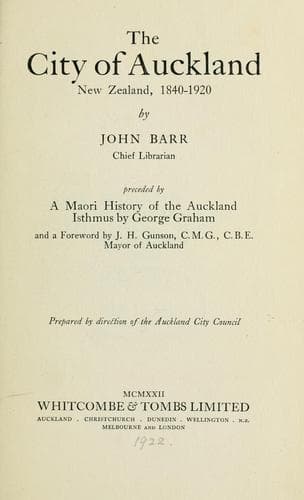
The City of Auckland, New Zealand, 1840-1920Barr, John
History
The City of Auckland, New Zealand, 1840-1920
Barr, John
Auckland (N.Z.) -- History
The inter-colonial service has been carried on regularly by the
Huddart-Parker and the Union lines, while the latter has practically
gained a monopoly of the inter-provincial and the Island services.
[Illustration: Photograph of Auckland taken from a seaplane, showing
the City's position between the two harbours, the Waitemata in the
front and the Manukau in the background
_W. A. Waters, Photo._]
An industrial disturbance, which ended in a general strike, paralysing
the trade of the Dominion, occurred at the end of 1913. The trouble
began with the miners in 1912, but the strikes of the Wellington
shipwrights and the Huntly miners, which took place simultaneously
in October, 1913, brought out other trades, including the waterside
workers, and for some weeks the commerce and industry of the Dominion
were at a standstill. Even the city trams ceased running. After a
fortnight, free labour became available and rapidly grew in extent.
Within a month the city became normal. One of the features of the
strike was the introduction of special police, who were enlisted to
protect the free labourers. The Auckland special police included
over 800 mounted men, who camped in the Domain. Although feeling
between the unionists and the strike-breakers ran high, there was no
conflict at any time.
During the following years there were a number of industrial disputes,
but in the war period strikes were not resorted to. The "go-slow"
policy was, however, introduced during the later stages of the war, and
caused considerable inconvenience. In 1919 the strike reappeared and
coal supplies became so short that public conveniences, such as gas
and electricity, were affected, and their curtailment became frequent.
The railway services were also affected, only the briefest time-tables
being carried out. In 1920 complete suspension of both trams and gas
supplies occurred, owing to lack of fuel. On two occasions the trams
ceased running--from January 31st to February 13th, and from September
25th to October 11th. Almost simultaneously with the second suspension
of the trams the gas supply was entirely stopped, the period being from
September 30th until October 14th.
Another strike, which was not appreciated by the public, was the
butchers' strike, which lasted from November 15th to December 6th, 1919.
The jockeys' strike, which took place at the Avondale races on April
10th, 1920, was a small affair in itself, and would not merit mention
if it were not for the events which followed it. On June 3rd the
tramwaymen detailed for duty on the race cars refused to run the "race
specials" and were suspended. The other tramwaymen, out of sympathy
with these men, ran their cars into the depôts. The City Council, which
had taken over the system from the Auckland Tramway Company, considered
that the men had struck, and the service was not resumed until June
8th, when the dispute was settled.
Public-domain text, read in full here on John Shaqi.
Reviews
Reviews
No reviews yet
Be the first to share your thoughts on this work.
Elsewhere in the archive
Join the Discussion
Join the discussion
Sign in to leave a comment or review.
Sign InorCreate an account