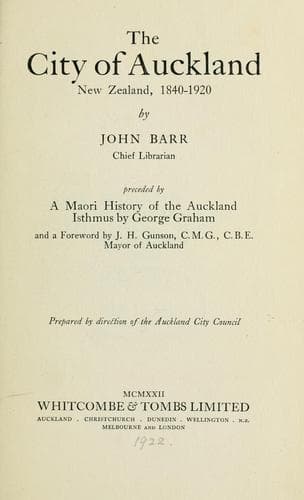
The City of Auckland, New Zealand, 1840-1920Barr, John
History
The City of Auckland, New Zealand, 1840-1920
Barr, John
Auckland (N.Z.) -- History
Between the jockeys' strike and its sequel--the tramways dispute--the
railwaymen came out, on account of dissatisfaction with their
conditions. The strike commenced on April 27th, and the dispute
threatened to be a most serious affair. It lasted for less than a week,
the men returning to duty on May 2nd. If the dispute had not been thus
speedily settled, the results, both economic and commercial, would
have been disastrous to the community. This event took place when the
Prince of Wales had just commenced his tour of New Zealand. He was then
at Rotorua, but the men on the train agreed to bring the Royal visitor
back to Auckland. This unscheduled hold-up of the tour was taken in a
philosophic spirit by His Royal Highness.
The European War, which fell on the world with such suddenness,
soon became felt on this side of the globe. The report at first
brought consternation to New Zealanders, with which was mingled the
usual display of patriotic ardour. Bands of youths and young men
paraded Queen Street, singing patriotic songs and demonstrating. To
many business people the idea of war spelt ruin, and many of them
immediately curtailed their staffs. Within a very short time--a
fortnight at most--these extreme expressions of the public mind settled
down, and the true feelings of the community found vent. The New
Zealand Government at once offered Great Britain its assistance, which
was as speedily accepted. On August 10th the first portion of Auckland
volunteers for overseas service left for Wellington, to join the other
units which formed the advance party of the N.Z.E.F. for the Samoan
expedition. From this onwards there were regular concentrations of men
for the forces, and at intervals the troops left for the seat of war.
The embarkations were usually made from Wellington, but in the earlier
days of the war the troops sometimes left from other ports, including
Auckland. One of the most memorable send-offs to outgoing troops took
place on September 23rd, 1914, when 2000 soldiers paraded at the
Auckland Domain, and were ceremonially farewelled by the citizens,
the Prime Minister (the Rt. Hon. W. F. Massey) and the Mayor (Mr. C.
J. Parr, C.M.G.) addressing the men. A similar event took place on
the occasion of the embarkation of the Second Maori Reinforcements,
on 17th September, 1915. This departure was an impressive spectacle,
as the older Maoris and their women-folk carried out the ceremony in
traditional manner. The Mayor (Mr. J. H. Gunson) presided at the
ceremony, which took place outside the Town Hall.
In the first months of the war a training camp for local recruits
was located at Epsom, but as the Dominion's military organisation
developed, this camp was abandoned, and the Auckland recruits went
direct to Trentham or one of the other concentration camps. The only
permanent camp in the Auckland district was at Narrow Neck, Devonport,
where the Maoris and recruits from the South Seas underwent their
course of training.
Public-domain text, read in full here on John Shaqi.
Reviews
Reviews
No reviews yet
Be the first to share your thoughts on this work.
Elsewhere in the archive
Join the Discussion
Join the discussion
Sign in to leave a comment or review.
Sign InorCreate an account