The Coal Measures Amphibia of North AmericaMoodie, Roy Lee
Science
The Coal Measures Amphibia of North America
Moodie, Roy Lee
Amphibians, Fossil -- North America; Paleontology -- Carboniferous; Paleontology -- North America
Produced by Tom Cosmas compiled from images made available
by The Internet Archive.
Transcriber Note
Text emphasis denoted as _Italics_ and =Bold=. Whole and fractional
parts of numbers as 123-4/5.
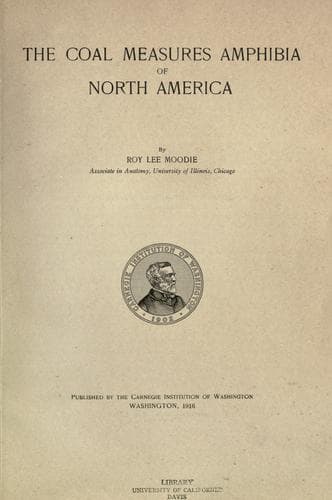
THE COAL MEASURES AMPHIBIA
OF
NORTH AMERICA
By
ROY LEE MOODIE
_Associate in Anatomy, University of Illinois, Chicago_
[Illustration]
Published by the Carnegie Institution of Washington
WASHINGTON, 1916
CARNEGIE INSTITUTION OF WASHINGTON
Publication No. 238
PRESS OF J. B. LIPPINCOTT COMPANY
PHILADELPHIA
PREFATORY NOTE.
The Carnegie Institution of Washington has already published several
monographs upon paleobiological subjects, written by its research
associates, Hay, Wieland, and Case. Each author has dealt with the
subject-matter of his particular field, but each has brought to bear upon
his work common factors which have placed his labors upon a broader basis
than the mere morphological descriptions of fossil forms of life. Case
has published four monographs upon the morphology and taxonomy of the
Permo-Carboniferous vertebrates of North America, and has followed these
by a fifth, in which all the known factors bearing upon the development of
the life were assembled in an effort to discuss the paleogeography of the
period. In his conception paleogeography is a very broad term, involving
not only a study of the distribution of land, water, and life in any one
interval of time, but a consideration of all the factors in the extremely
complex inter-relations of organic and inorganic matter and causes which
influence the development of each part.
Geologists and paleobiologists have alike suffered in their interpretation
of past conditions, because of their lack of knowledge of the work
done by others. Stratigraphy may not be interpreted from the preserved
fossils without a knowledge of biological laws, and the formations of the
earth may not safely be rearranged to account for the present or past
distribution of life without a knowledge of geological processes.
It is obvious that such work is beyond the possibilities of any one man;
it is rather the work of a group of men, each broadly trained and each
master of his own field and able to contribute to and criticize the
work of his fellows. Nowhere could close cooperation of this kind be
better accomplished than under a system such as the Carnegie Institution
of Washington has developed, whereby the research associates of the
Institution and others of its staff may call in the assistance of men in
related fields. Already the value of this procedure is apparent in the
results accomplished by cooperation.
Public-domain text, read in full here on John Shaqi.
Reviews
Reviews
No reviews yet
Be the first to share your thoughts on this work.
Join the Discussion
Join the discussion
Sign in to leave a comment or review.
Sign InorCreate an account