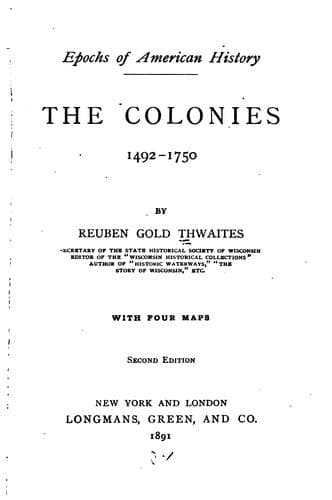
United States -- History -- Colonial period, ca. 1600-1775
apple-paring bees, into which the neighborhoods entered with great zest. In
the towns there was more pretension and ceremonial; but taking changed
conditions into account, the life of the townspeople and their habits of
thought differed but little from those of their rural cousins.
Sidenote: Roads and travel.
The highways were generally of fair character, but the larger streams were
unbridged. Outside of the neighborhoods of the large towns wheeled
vehicles, except for heavy loads, were not common until the time of the
Revolution. Horseback was the ordinary mode of travel. A tavern kept by
some leading citizen could be found in every town, with good lodgings at
reasonable rates, although there was general complaint of the cookery.
Nowhere else in the colonies was there so much intercommunication as in New
England.
79. Moral and Religious Conditions.
Sidenote: Education.
A system of public education was among the first institutions established
by the Puritans. Each town had its school; by 1649 there was no New England
colony, except Rhode Island, in which some degree of education was not
compulsory. Deep learning was rare, but the people were well drilled in the
rudiments; except on the far-off borders of Maine there was no illiteracy
in New England when the Revolution broke out. Latin schools and academies
soon supplemented parental instruction and the common schools. We have seen
that Boston was but six years old when Harvard College was established
(1636); and Yale College was opened at New Haven in the year 1700.
Sidenote: Crime.
Crime appears to have been less frequent in New England than in the
Southern or the middle colonies; the highways were safe after the close of
King Philip's war and the Tarratine trouble; doors and windows were seldom
barred in the country, and young women could travel anywhere with perfect
safety. The list of capital crimes was a long one in that day, as well in
the mother-land as in the colonies, and hangings, particularly of the
pirates who infested the coast, were spectacles frequently seen in New
England. A more cruel form of punishment was reserved for the negro race.
There were several cases of negroes being burned at the stake for murder or
arson. Great publicity was given to all manner of punishments; gibbets,
stocks, ducking-stools, pillories, and whipping-posts were familiar objects
in nearly every town. Criminals might also be branded, mutilated, or
compelled to wear, conspicuously sewed to their garments, colored letters
indicative of the offences committed. Hawthorne's romance of the "Scarlet
Letter" is based on this last-named custom.
Sidenote: Religion.
Public-domain text, read in full here on John Shaqi.
Reviews
Reviews
No reviews yet
Be the first to share your thoughts on this work.
Elsewhere in the archive
Join the Discussion
Join the discussion
Sign in to leave a comment or review.
Sign InorCreate an account