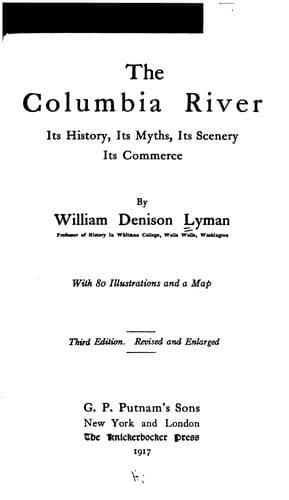
The Columbia River: Its History, Its Myths, Its Scenery, Its CommerceLyman, William Denison
History
The Columbia River: Its History, Its Myths, Its Scenery, Its Commerce
Lyman, William Denison
Columbia River; Columbia River -- Description and travel; Columbia River -- History
W. H. Gray, the secular agent, was a young, fine-looking, daring, and
athletic man, very skilful in making and handling boats, teams, waggons,
and anything else of a practical nature. He was so positive and even
violent in his views as to alienate many with whom he came in contact. Yet
he was one of the manliest men that ever came to Oregon, and was
intimately connected with nearly every important event in the history of
the Columbia River, navigation included. His four sons, all born in
Oregon, became steamboat captains and pilots, and without question, no one
family has been so intimately associated with the River as has the Gray
family. If any one group of people could be said to have filed a claim on
the River, it is the family of W. H. Gray. Gray's history is of high
value, yet so intense was his hatred of the Hudson's Bay Company and of
the British in general, as well as of Roman Catholics, that his book has
been subjected to unsparing criticism by later writers.
The little missionary band of five, accompanied by the two Nez Perce
Indians who had gone East with Whitman the year before, joined the
westbound caravan of the American Fur Company, and journeyed with them the
greater part of the way. One of the most thrilling and suggestive moments
in their journey was when they stood on the summit of the Rockies at South
Pass. There they looked down the westward maze of mountains and valleys
drained by the Snake River and its tributaries as these swept west to join
the Columbia and thence proceed to the Pacific. With that vision before
them, they spread the Stars and Stripes to the breeze and kneeling upon
the turf, they took possession of the great unknown to the westward in the
name of God and the American Union. Nobly was the claim maintained, though
with it came the crown of martyrdom.
Whitman desired above all other things to demonstrate the feasibility of a
waggon road to the Pacific. He therefore insisted on taking his
waggon,--"_Chick-chick-shaile-kikash_," the Indians called it, in
attempted onomatopoeia. His demonstration was successful, though the
trouble was infinite. He was compelled to leave the waggon at the Hudson's
Bay Fort on the Boise, near the present site of Boise City, with the
intention of getting it the next year. The Hudson's Bay people used every
effort to discourage Whitman in his waggon enterprise, though according to
Gray, they made much use of the vehicle in their fort.
On September 2, 1836, the mission party reached the Hudson's Bay Company's
fort at the mouth of the Walla Walla, a little more than four months and
two thousand two hundred miles from the banks of the Missouri to those of
the Columbia.
Public-domain text, read in full here on John Shaqi.
Reviews
Reviews
No reviews yet
Be the first to share your thoughts on this work.
Elsewhere in the archive
Join the Discussion
Join the discussion
Sign in to leave a comment or review.
Sign InorCreate an account