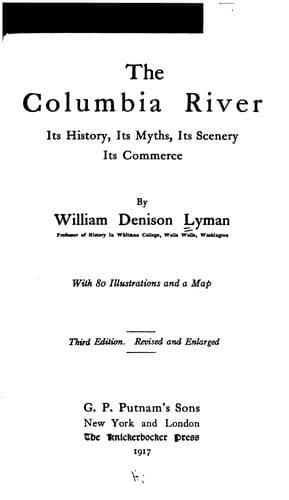
The Columbia River: Its History, Its Myths, Its Scenery, Its CommerceLyman, William Denison
History
The Columbia River: Its History, Its Myths, Its Scenery, Its Commerce
Lyman, William Denison
Columbia River; Columbia River -- Description and travel; Columbia River -- History
But the journey was not complete, for their definite location must yet be
selected. They proceeded now in bateaux down the Great River to Vancouver,
the headquarters of the Hudson's Bay Company's empire. There Dr.
McLoughlin, the chief factor, met them with his own peculiar cordiality,
and yet with the dignity befitting the head of so great an establishment.
He was a noble man, and though business considerations and the orders of
the directors of the company would have led him to "freeze out" the
Americans, yet humanity and his own genial nature forbade him to withhold
the cordial hand from the mission band. The fort and two ships in the
river were arrayed in gala attire in honour of the event. Dr. McLoughlin
did the honours of his spacious hall to Mrs. Whitman and Mrs. Spalding in
a style that would have graced a baronial mansion.
By Dr. McLoughlin's advice, since the Methodist mission had been located
in the Willamette Valley, Whitman decided to establish himself among the
Cayuses in the beautiful and fertile valley of the Walla Walla, at
Waiilatpu, the "Place of the Rye-grass." Spalding accepted the urgent
appeal of the Nez Perces to go a hundred and twenty-five miles eastward to
Lapwai on the Clearwater, near the modern site of Lewiston. Both stations
were fair to look upon, with every natural advantage. It proved, however,
that the Cayuses were fierce and intractable, while the Nez Perces, though
warlike and manly, were also docile, ambitious to learn, and predisposed
to friendly relations with the Americans.
In 1838, the American Board of Foreign Missions sent a reinforcement to
the field, consisting of Revs. Elkanah Walker, Cushing Eells, A. B. Smith,
and their wives. Mr. Gray, who had returned the previous year in order to
organise this reinforcement, had found a wife, and with her was now
accompanying this second missionary band to Oregon.
Messrs. Walker and Eells located at Tshimakain, on what is now called
Walker's Prairie, near Spokane. Mr. Smith went to Kamiah up the
Clearwater, about sixty miles from Mr. Spalding's station at Lapwai.
Time fails to speak of the many interesting events marking each of the
missions. They were all located in singularly attractive spots, and every
one of the missionaries made great progress in cultivating the ground,
building mills, houses, and fences, and interesting the Indians in the
arts of peace. It is true that when the novelty of the white man's ways
had passed, many of the natives lost all interest. Yet upon the Spokanes
and the Nez Perces, lasting influences were wrought. The Nez Perces in
particular, under the influence of their noble and intelligent chief,
Hal-hal-tlos-sot, or Lawyer, almost decided the fate of American
institutions in the upper Columbia River region for years.
Public-domain text, read in full here on John Shaqi.
Reviews
Reviews
No reviews yet
Be the first to share your thoughts on this work.
Elsewhere in the archive
Join the Discussion
Join the discussion
Sign in to leave a comment or review.
Sign InorCreate an account