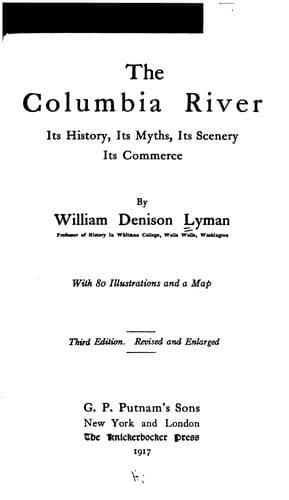
The Columbia River: Its History, Its Myths, Its Scenery, Its CommerceLyman, William Denison
History
The Columbia River: Its History, Its Myths, Its Scenery, Its Commerce
Lyman, William Denison
Columbia River; Columbia River -- Description and travel; Columbia River -- History
With a single white companion, A. L. Lovejoy, and one or more Indian
guides, he left Waiilatpu on October 3, 1842. His journey through snow,
ice, wind, hunger, peril, and deprivation of every sort, has been ofttimes
described. The extent of his influence in securing the adoption by our
Government of the policy of retaining Oregon has become the theme of
earnest, even acrimonious discussion. The simple fact remains that Oregon
was "saved" to the American Union. The missionaries Lee and Whitman bore,
each his part, and a great one, in the great final result. It is not too
much to say that of the various lines of influence by which the valley of
the Columbia became American territory, that of missions was one of the
strongest.
The Catholic missions of the Columbia Valley have found several
chroniclers, of whom the most valuable are Rev. F. N. Blanchet and Rev.
Pierre J. De Smet. The former in his book, _The Catholic Church in
Oregon_, gives a clear and circumstantial account of the founding and
carrying on of the work in the Willamette Valley. The latter in his
_Oregon Missions_, and _Western Missions and Missionaries_, has given a
singularly graphic and interesting report on religious progress, and with
it many charming descriptions of the scenery and other natural conditions
of the country.
Father Blanchet, in company with Rev. Modest Demers, went from Montreal to
Vancouver, a journey of over four thousand miles, in 1837. At the Little
Dalles of the Columbia, near the present Northport, a lamentable disaster
cost the lives of twelve of the company with whom they were travelling.
Reaching Vancouver on November 24, 1837, they received from Dr.
McLoughlin, who had himself been brought up a Catholic, a most cordial
welcome, though apparently not more cordial than the good man had given
Lee, the Methodist, and Whitman, the Presbyterian. The fact that there
were so many French Canadians in the country made the way of the Catholic
Fathers easier than that of the other missionaries. For the French, with
their gayety, sociability, and usual habit of intermarriage with the
Indians, were much more popular with them than were the more harsh and
reserved British and Americans. In fact the Catholic Fathers found a
building all ready for their use at the historic town of Champoeg on the
Willamette, thirty miles above Portland. There in 1836, the French
settlers had built a log church, the first church building in Oregon. It
is rather sad to relate that petty dissensions and jealousies marred the
relations between the Catholics and the Methodists. But both alike were
zealous and indefatigable in promoting the secular and religious interests
of both red men and white men.
Public-domain text, read in full here on John Shaqi.
Reviews
Reviews
No reviews yet
Be the first to share your thoughts on this work.
Elsewhere in the archive
Join the Discussion
Join the discussion
Sign in to leave a comment or review.
Sign InorCreate an account