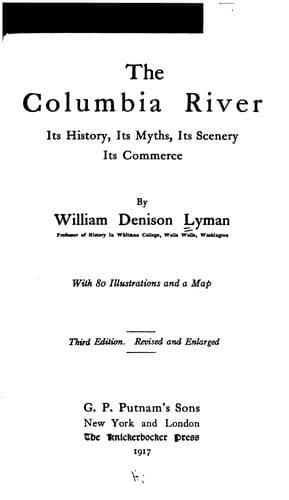
The Columbia River: Its History, Its Myths, Its Scenery, Its CommerceLyman, William Denison
History
The Columbia River: Its History, Its Myths, Its Scenery, Its Commerce
Lyman, William Denison
Columbia River; Columbia River -- Description and travel; Columbia River -- History
One of the especially interesting events in connection with the Nez Perce
mission was the acquisition by Mr. Spalding of the first printing-press
used west of the Rocky Mountains. This was donated by the church of Rev.
H. Bingham at Honolulu in 1839. The indefatigable Spalding, with the
assistance of his wife, who had unusual powers as a linguist, began at
once reducing the Nez Perce language to a written form and printing in it
translations of hymns and portions of the Bible. Some of these first books
of the Columbia River are still in existence. The venerable printing-press
is in the museum of the Oregon Pioneer Society at Portland.
The most dramatic and influential event in connection with the missions of
the Columbia, one of the most so in all American history, was Dr.
Whitman's mid-winter ride in 1842-43 from Waiilatpu to St. Louis. Dr.
Whitman, in common with Jason Lee, soon began to perceive that the
Columbia Valley possessed resources and a location which would inevitably
make it the seat of a civilised population. The corollary of this was that
the mission must conform to the movements of the whites and in time cease
to be simply an Indian mission. He perceived another thing. That was the
purpose of the Hudson's Bay Company to hold Oregon under English
possession and keep it a wilderness for the sake of the fur-trade. The
corollary of that was that, if American families could be induced to
locate in Oregon, they would in time topple the scale in favour of
American ownership.
The value of Oregon was then but dimly understood among the Americans.
Webster, Benton, and others of the great statesmen are on record in the
_Congressional Globe_ with many disparaging remarks upon "that worthless
Columbia River country."
Whitman watched all signs with anxious eye. Negotiations between England
and the United States indicated a probable surrender to the former. The
American Board was considering the abandonment of the mission. Looking
over the broad field of the future of the American nation with a
statesman's vision, Dr. Whitman readily saw that the interests of his
country and of Christian civilisation demanded the acquisition of Oregon.
Those interests were in jeopardy. He made the great resolution to proceed
at once to the "States" with the threefold aim: confer with the officers
of the American Board on the retention of the mission, confer with
President Tyler, Secretary Webster, and such others of the officers of
government as he could see at Washington, and finally help organise and
lead back to Oregon an American immigration. His fellow-missionaries
strongly opposed his purpose. They felt that it was abandoning the
religious aims of the mission to take up political questions. But he
declared that he had not expatriated himself by becoming a missionary. Go
he would. The undertaking seemed chimerical, even desperate. But Whitman
was bold, athletic, persistent, possessing all the qualities of a hero.
Public-domain text, read in full here on John Shaqi.
Reviews
Reviews
No reviews yet
Be the first to share your thoughts on this work.
Elsewhere in the archive
Join the Discussion
Join the discussion
Sign in to leave a comment or review.
Sign InorCreate an account