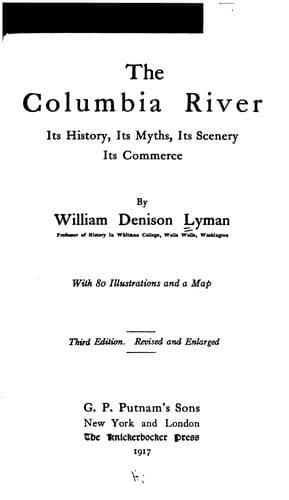
The Columbia River: Its History, Its Myths, Its Scenery, Its CommerceLyman, William Denison
History
The Columbia River: Its History, Its Myths, Its Scenery, Its Commerce
Lyman, William Denison
Columbia River; Columbia River -- Description and travel; Columbia River -- History
Wyeth conceived the idea of a great trading company on the Columbia, whose
operations would necessarily create rivalry with the British. His design
was to send companies across the continent to the Columbia head-waters and
to maintain also ship connection by way of Cape Horn. He believed that a
ship load of salmon from the Columbia River to the Atlantic sea-board
would be a paying venture. On so large a scale did he lay out his
enterprise that he expected soon to have a business of two hundred
thousand dollars a year. But he looked beyond the fur and salmon business
to American possession and settlement, at least south of the River to the
California line. He therefore embraced in his view the building of
enterprises which should lead up to and then profit by American
immigration. Wyeth spent five years in Oregon, having many interesting
adventures, and as many business reverses. As was the case with Astor, the
British fur-traders proved too powerful for the Yankee. Among other
undertakings, he built a fort on Sauvie's Island at the mouth of the
Willamette, which he called Fort William. He desired to make this the
basis of his trade, and he expected the Indians to go there to trade. But
such was the influence of the Hudson's Bay people and their employees with
the Indians that Wyeth's fort had no trade. It was during those years that
a frightful pestilence swept the natives away like flies, and there was
great fear among them that Wyeth's fort might harbour the scourge. The
period of Wyeth's enterprise in Oregon extended from the spring of 1832 to
the autumn of 1836. Though not a business success, it had a great bearing
on the creation of an interest in Oregon, and on preparing for immigration
a few years later. It opened the eyes of many Americans to the attractions
of Oregon and to the tremendous power and profits of the Hudson's Bay
Company.
The next movement may be called a real immigration to Oregon. It consisted
of a party of nineteen, commonly known as the "Peoria party," since they
went from Peoria, Ill. Jason Lee, the missionary of Chemeketa, delivered a
lecture at that place in 1838, and so much interest in Oregon was aroused
that in the year following, the Peoria party, the first regular party
from the Mississippi Valley, set forth for the River of the West. Their
leader, T. J. Farnham, christened his followers the "Oregon Dragoons" and
Mrs. Farnham gave them a flag with the inscription, "Oregon or the Grave."
Farnham declared his purpose to seize Oregon for the United States.
Public-domain text, read in full here on John Shaqi.
Reviews
Reviews
No reviews yet
Be the first to share your thoughts on this work.
Elsewhere in the archive
Join the Discussion
Join the discussion
Sign in to leave a comment or review.
Sign InorCreate an account