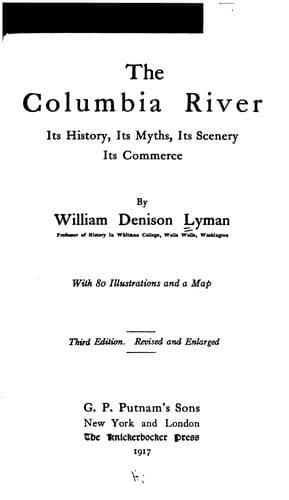
The Columbia River: Its History, Its Myths, Its Scenery, Its CommerceLyman, William Denison
History
The Columbia River: Its History, Its Myths, Its Scenery, Its Commerce
Lyman, William Denison
Columbia River; Columbia River -- Description and travel; Columbia River -- History
The Peoria party had the good fortune to have two writers in the number,
whose accounts possess rare interest. These writers were the leader
Farnham, and Robert Shortess. The party went to pieces at Bent's Fort on
the Arkansas, but its members reached Oregon somewhat in driblets during
that year, and the one following. Shortess reached the Whitman Mission at
Walla Walla in the fall of 1839, and there he remained until the following
spring, when he went down the River to The Dalles. From The Dalles, he
made his way over the Cascade Mountains to the Willamette Valley, and
there he lived many years. Farnham also finally reached Oregon, but his
avowed mission was unfulfilled. Shortess says of him: "Instead of raising
the American flag and turning the Hudson's Bay Company out-of-doors, he
accepted the gift of a suit of clothes and a passage to the Sandwich
Islands, and took a final leave of Oregon." But upon his return to the
"States," Farnham published a _Pictorial History of Oregon and
California_, a book of many interesting features, and one which played a
worthy part in waking the people of the Mississippi Valley to the
attractions of the Pacific Coast.
Soon after the close of Wyeth's enterprise, there were two notable
government expeditions to the Columbia River. One was commanded by Sir
Edward Belcher of the British Navy, and the other by Lieutenant Charles
Wilkes of the American Navy. The Wilkes expedition was one of the most
interesting and important ever undertaken by the United States Government.
The squadron consisted of two sloops-of-war, the _Peacock_ and the
_Vincennes_, the store ship, _Relief_, the brig, _Porpoise_, and the
schooners, _Sea Gull_ and _Flying Fish_. This fine squadron took up its
principal station on Puget Sound, from which extensive surveys were made,
one across the mountains to Fort Okanogan; another of the Cowlitz Valley
and the Columbia River as far as Wallula.
One of the most important results of this elaborate Wilkes expedition was
to establish in the minds of officers of the Government the essential
unity of all parts of the Pacific Coast and the boundless opportunities
offered to American immigration. Wilkes and his intelligent officers
readily grasped, and conveyed through an elaborate report to the
government, the idea that Puget Sound was an inherent and integral part of
Oregon and that the Columbia Basin was essential to the proper development
of American commerce upon the Pacific. They may also have forecast the
time when California with her girdles of gold and chaplets of freedom
would spring, Athena-like, from the Zeus brain of American enterprise. The
control of the River was the key to the control of the entire coast from
San Diego to the Straits of Fuca;--and American ownership should have
extended to Sitka.
Public-domain text, read in full here on John Shaqi.
Reviews
Reviews
No reviews yet
Be the first to share your thoughts on this work.
Elsewhere in the archive
Join the Discussion
Join the discussion
Sign in to leave a comment or review.
Sign InorCreate an account