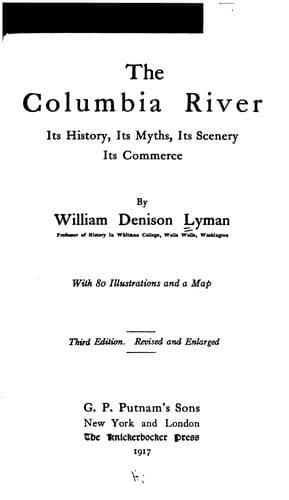
The Columbia River: Its History, Its Myths, Its Scenery, Its CommerceLyman, William Denison
History
The Columbia River: Its History, Its Myths, Its Scenery, Its Commerce
Lyman, William Denison
Columbia River; Columbia River -- Description and travel; Columbia River -- History
Doubtless the immigrants, as they stood by the River in the pleasant haze
of the October afternoon, felt as though their journey was substantially
at an end. Being now at Fort Walla Walla on the river of that name, they
paused to make ready for the last stage of the journey, little realising
what perils and sufferings it would entail. Dr. Whitman and Archibald
McKinley, the chief factor at the fort, advised them to leave their cattle
and waggons to winter on the Walla Walla, while they pursued their way
down the stream on flatboats. Part of the company accepted the advice, but
a number determined to keep all their belongings together and to take
their road along the bank of the River to The Dalles, and there make their
flatboats.
To those who remained on the Walla Walla now fell the difficult task of
constructing flatboats. Huge, uncouth, structures they were, made of
timber gathered on the river bank. But when loaded and pushed out into the
swift current, steered with immense sweeps in the stern, these flatboats
afforded to the footsore and exhausted immigrants a delightful change. Out
of the dust, off the rocks, away from the sage-brush, with more of laugh
and song than they had had for many a day, they swept gaily on. For a
hundred miles or more the elements were propitious. With the bright
sunshine, the clear, cool water, the majestic snow-peaks in the distance,
the easily gliding boats,--this seemed the pleasantest part of the entire
journey. But after The Dalles had been reached and the two divisions of
the company were again united and on their way down the River to the
Cascades, disaster began to haunt them. At the Cascades, a boat with
several members of the Applegate family, one of the most prominent in the
immigration as well as afterwards, was overturned in the rapids, and three
of the party drowned in the boiling surge. Two were saved in a way that
seems almost miraculous. One of these was a young boy, the other a young
man. The boy was very active and an excellent swimmer. After the
overturning of the boat he was carried two miles in the current, part of
the time being entirely sucked under by the whirling under-current. After
being tossed with violence betwixt rock and wave till it seemed that he
must expire, he was suddenly spewed forth upon a ledge of slippery rock,
to which he clung desperately till he had recovered breath. Then he drew
himself up on a narrow shelf, and at the same instant saw the young man
swept by. Reaching forth, the brave boy managed to bring the struggling
man to the same shelter with himself. But when they had regained
sufficient strength to examine their surroundings, they discovered that
they were on a rocky niche from which they could find no ascent of the
ragged precipitous cliff. They were in a trap. Looking across the River,
they could see that the bank was smooth and that on that side lay the
trail. Young Applegate saw that a reef extended a considerable part of the
Public-domain text, read in full here on John Shaqi.
Reviews
Reviews
No reviews yet
Be the first to share your thoughts on this work.
Elsewhere in the archive
Join the Discussion
Join the discussion
Sign in to leave a comment or review.
Sign InorCreate an account