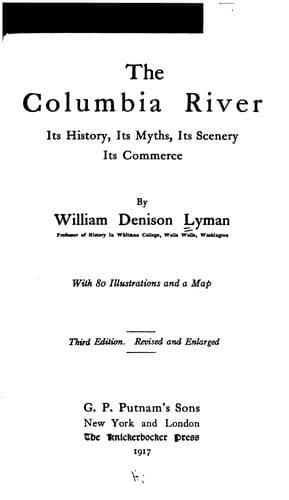
The Columbia River: Its History, Its Myths, Its Scenery, Its CommerceLyman, William Denison
History
The Columbia River: Its History, Its Myths, Its Scenery, Its Commerce
Lyman, William Denison
Columbia River; Columbia River -- Description and travel; Columbia River -- History
Great was the astonishment of Captain Grant, commandant of the Hudson's
Bay Fort Hall on Snake River, near the present Pocatello, when the long
train filed past the enclosure. Grant had known Whitman before and was
aware of his stubborn determination and patriotic purpose. But Grant
attempted just the same to dissuade the immigrants of 1843 from going
farther with their waggons, declaring the Blue Mountains to be impassable.
The doughty doctor simply laughed quietly and told the immigrants to push
on, and he would see them through. But just as they were entering the
rough defiles of the Blue Mountains, a band of Indians from Waiilatpu,
headed by Sticcus, came to meet the train, searching for Whitman, telling
him that his medical services were in great demand at Lapwai. The
much-needed guide turned over the pilotage of the train to Sticcus, and he
himself hastened on to minister to the sick at Lapwai. As he passed
through Waiilatpu he learned that the threatening conduct of the Indians
had led Mrs. Whitman to go to Vancouver, and that during his absence the
Indians had burned his mill and committed other depredations. But it was
his lot to labour and suffer. He had become accustomed to it.
The event proved that Sticcus was a thoroughly capable guide. For, though
not speaking a word of English, he made his directions so well understood
by pantomime that, as Mr. Nesmith has said, he led them safely over the
roughest mountain road that they ever saw. And so in due time the train
emerged from the screen of timber on the Blue Mountains. Stretched wide
before them, lay the plains of Umatilla and Walla Walla, while in the far
distance the River of the West poured through the arid waste. Yet farther
the snow summits of the Cascades ridged the western sky. After a brief
pause at Waiilatpu, the train reached the banks of the River. The
immediate vicinity of the section of the River first reached is very dry
in autumn. Aside from the River itself, the immediate scene is desolate
and forbidding. But probably those immigrants of '43 gazed upon the blue
flood, a mile wide and hastening to the western ocean, with feelings
almost akin to those which swelled the hearts of the Pilgrims landing from
the _Mayflower_. This was another epic of state-making, and one generation
after another of the Americans who have wrought such achievement may well
turn back to join hands with those before.
Public-domain text, read in full here on John Shaqi.
Reviews
Reviews
No reviews yet
Be the first to share your thoughts on this work.
Elsewhere in the archive
Join the Discussion
Join the discussion
Sign in to leave a comment or review.
Sign InorCreate an account