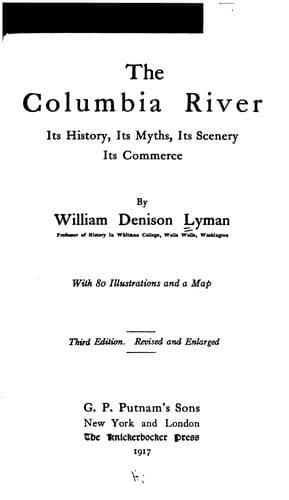
The Columbia River: Its History, Its Myths, Its Scenery, Its CommerceLyman, William Denison
History
The Columbia River: Its History, Its Myths, Its Scenery, Its Commerce
Lyman, William Denison
Columbia River; Columbia River -- Description and travel; Columbia River -- History
After this happy pause at Vancouver, the immigration passed on to the
Willamette Falls, then the centre of operations in Oregon, and there they
were soon joined by the chosen men who had driven their thirteen hundred
head of cattle by the trail over the Cascade Mountains, a task toilsome
and even distressing, but one that was accomplished. After an inactive
winter in the mild, muggy, misty Oregon climate, the immigrants of '43
spread abroad in the opening spring to secure land, each his square mile,
as the Provisional Government provided, and as the American government was
contemplating.
Such was the coming of the immigrants to the River. Subsequent
immigrations bore a general resemblance to that of 1843. Each had its
special feature. That of 1845 was conspicuous for its size. It was three
thousand strong. It was also illustrious for the laying out of the road
across the Cascade Mountains near the southern flank of Mt. Hood. This
noble and difficult undertaking was carried through by S. K. Barlow and
William Rector. It was a terrific task, and was not completed the first
year. Canyons, precipitous rocks, morasses, sand-hills, tangled forests,
fallen trees, criss-crossed and interlaced with briars and vines and
shrubbery of tropical luxuriance, such as no one can appreciate who has
not seen an Oregon jungle,--these were the obstructions to the Barlow
Road. But they were vanquished and in 1846 and thence onward the
immigrants made this the regular route to the Willamette Valley. So steep
was Laurel Hill on the western slope that waggons had to be let down by
ropes from level to level. The marks of the ropes or chains are still seen
on the trees of Laurel Hill. The immigration of 1852 was sadly conspicuous
for the devastations of cholera. Many a family was broken in sunder and
some even were entirely eliminated by the dreadful plague. The
immigrations of 1854 and 1855 were notable for the Indian outbreaks, and
especially for the atrocious butchery of the Ward family near Boise in the
earlier year, the most pitiless Indian outrage in Oregon history.
Public-domain text, read in full here on John Shaqi.
Reviews
Reviews
No reviews yet
Be the first to share your thoughts on this work.
Elsewhere in the archive
Join the Discussion
Join the discussion
Sign in to leave a comment or review.
Sign InorCreate an account