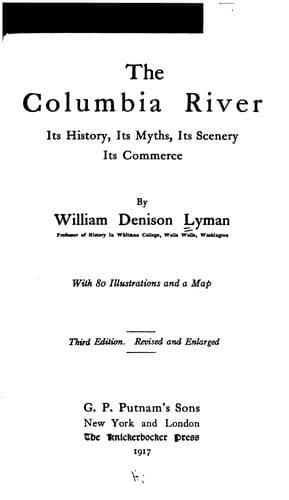
The Columbia River: Its History, Its Myths, Its Scenery, Its CommerceLyman, William Denison
History
The Columbia River: Its History, Its Myths, Its Scenery, Its Commerce
Lyman, William Denison
Columbia River; Columbia River -- Description and travel; Columbia River -- History
From 1850 onward for some years the Donation Land Law of Congress was a
great lure to immigrants, for by it a man and wife could obtain a section
of land. A single man could take up half a section. That situation
encouraged early marriages. Girls were in great demand. It was not
uncommon to see fourteen-year-old brides. Some narrators relate having
found married women in the woods of the Columbia who were playing with
their dolls! But though the immigrations varied in special features, they
were all alike in their mingling of mirth and melancholy, of toil and
rest, of suffering and enjoyment, of heroism, and self-sacrifice. They
embodied an epoch of American history that can never come again. To have
been an immigrant from the Missouri to the Columbia was an experience to
which nothing else on earth is comparable. It confers a title of American
nobility by the side of which the coronets of some European dukes are
tawdry and contemptible. Perhaps no one ever better phrased the spirit of
Oregon immigration than Jesse Applegate of the train of '43, one of the
foremost of Oregon's builders, long known as the "Sage of Yoncalla." So
fitting do we deem his language that we quote here an extract from one of
his addresses.
The Western pioneer had probably crossed the Blue Ridge or the
Cumberland Mountains when a boy and was now in his prime. Rugged,
hardy, and powerful of frame, he was full to overflowing with the love
of adventure, and animated by a brave soul that scorned the very idea
of fear. All had heard of the perpetually green hills and plains of
Western Oregon, and how the warm breath of the vast Pacific tempered
the air to the genial degree and drove winter back to the North. Many
of them contrasted in imagination the open stretch of a mile square of
rich, green, and grassy land, where the strawberry plant bloomed
through every winter month, with their circumscribed clearings in the
Missouri bottoms. Of long winter evenings neighbours visited each
other, and before the big shell-bark hickory fire, the seasoned walnut
fire, the dry black-jack fire, or the roaring dead elm fire, they
talked these things over; and as a natural consequence, under these
favourable circumstances, the spirit of emigration warmed up; and the
"Oregon fever" became as a household expression. Thus originated the
vast cavalcade, or emigrant train, stretching its serpentine length
for miles, enveloped in vast pillars of dust, patiently wending its
toilsome way across the American continent.
Public-domain text, read in full here on John Shaqi.
Reviews
Reviews
No reviews yet
Be the first to share your thoughts on this work.
Elsewhere in the archive
Join the Discussion
Join the discussion
Sign in to leave a comment or review.
Sign InorCreate an account