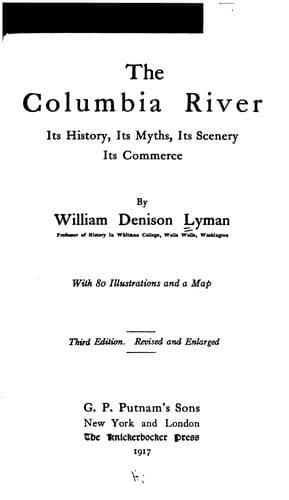
The Columbia River: Its History, Its Myths, Its Scenery, Its CommerceLyman, William Denison
History
The Columbia River: Its History, Its Myths, Its Scenery, Its Commerce
Lyman, William Denison
Columbia River; Columbia River -- Description and travel; Columbia River -- History
Stripes took place. Captain J. Hickey of the _Blossom_ represented Great
Britain, Mr. J. Keith acted for the North-west Fur Company, while Mr.
Provost stood for the United States. It seems to have been a very
good-natured affair throughout. Placards were posted at the capes on both
sides of the River declaring the change of sovereignty. Fort George was
quite a powerful structure at that time, consisting of a strong stockade
of fir logs twelve feet high, enclosing a parallelogram one hundred and
fifty by two hundred and fifty feet, having within it dwellings, shops,
store houses, and magazines. On the walls were two eighteen-pound cannon,
six six-pounders, four four-pound carronades, two six-pound cohorns, and
seven swivels. The day of transfer must have been a very picturesque day
among the many such in Astoria's history. We can imagine the soft October
haze floating over Cape Hancock, and the long, lazy swell of six thousand
miles of sea, thundering across Point Adams.
One interesting feature of Mr. Provost's presence at Astoria was his
observation of the bar at the entrance of the River. This had generally
been represented to the world as something frightful. It is often so
represented at the present time. Mr. Provost in a letter to Secretary of
State, John Quincy Adams, says that there is a spacious bay, by no means
so difficult of ingress as has been represented. He states that there is
a bar across the mouth of the River, at either extremity of which there
are sometimes appalling breakers; but that there is a channel of nearly a
league in width with a depth of twenty-one feet at the lowest tides. He
thinks, therefore, that with proper buoys the access to vessels of almost
any tonnage may be rendered secure. This statement in regard to the Bar is
of much interest as furnishing a basis for comparison with the present
conditions. The depth at low tide now is about twenty-six feet, the
increase probably being due to the jetty.
The logic of the restoration of Astoria to the United States, while at the
same time the British Fur Company was left in practical possession, was
realised in the Joint Occupation Treaty of 1818. By this singular
arrangement it was agreed that any country on the north-west coast of
America that may be claimed by either power shall be open for ten years to
the vessels, citizens, and subjects of the two powers.
Public-domain text, read in full here on John Shaqi.
Reviews
Reviews
No reviews yet
Be the first to share your thoughts on this work.
Elsewhere in the archive
Join the Discussion
Join the discussion
Sign in to leave a comment or review.
Sign InorCreate an account